

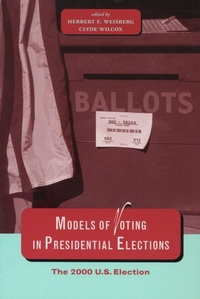
Models of Voting in Presidential Elections
The 2000 U.S. Election
Published on 30. September 2003
Book
Hardback
320 pages
978-0-8047-4855-1 (ISBN)
Description
Models of Voting in Presidential Elections offers a comprehensive scholarly examination of the determinants of voter participation and vote choice at play in the 2000 presidential election. Unlike other books that focus exclusively on the drama and unusual circumstances of the 2000 election, this account examines larger issues surrounding the election and its outcome, asking why an election that traditional forecasting models predicted would provide a strong and clear victory for one side was ultimately so close.
Using a variety of models, the authors explore why the election was so close, what happened to the landslide that economic forecast models had predicted, and whether our traditional theories and approaches require reevaluation in light of the outcome.
This book analyzes a variety of matters fundamental to the 2000 election, including the influence of Bill Clinton, his dual legacy, and the economy. The authors detail changing voter coalitions and the influence of a gender gap. They also describe the role of divided government, how voter turnout affects election outcomes, the impact of minor-party candidates, and, more generally, the relative importance of partisanship, candidates, and issues.
Using a variety of models, the authors explore why the election was so close, what happened to the landslide that economic forecast models had predicted, and whether our traditional theories and approaches require reevaluation in light of the outcome.
This book analyzes a variety of matters fundamental to the 2000 election, including the influence of Bill Clinton, his dual legacy, and the economy. The authors detail changing voter coalitions and the influence of a gender gap. They also describe the role of divided government, how voter turnout affects election outcomes, the impact of minor-party candidates, and, more generally, the relative importance of partisanship, candidates, and issues.
Reviews / Votes
"A scholarly and intellectually interesting collection that will provide students with good examples of analytic approaches to studying elections. It is the best collection available on the 2000 election and should have genuine appeal to anyone interested in the 2000 election and American politics more generally." -George Rabinowitz,University of North Carolina "Few books cover the topic of modeling presidential elections in such an accessible manner. None had a more fascinating election than the 2000 election to work with." -John C. Green,The University of AkronMore details
Edition
New edition
Language
English
Place of publication
Palo Alto
United States
Publishing group
Stanford University Press
Target group
College/higher education
Professional and scholarly
Edition type
New edition
Product notice
Cloth
Illustrations
59 tables, 14 figures
Dimensions
Height: 240 mm
Width: 152 mm
Thickness: 25 mm
Weight
567 gr
ISBN-13
978-0-8047-4855-1 (9780804748551)
Copyright in bibliographic data and cover images is held by Nielsen Book Services Limited or by the publishers or by their respective licensors: all rights reserved.
Schweitzer Classification
Persons
Herbert F. Weisberg is Professor of Political Science at the Ohio State University. Clyde Wilcox is Professor of Government at Georgetown University.