

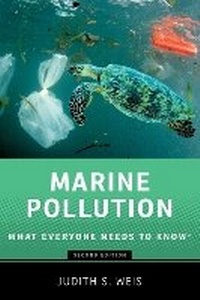
Marine Pollution
What Everyone Needs to Know (R)
2nd Edition
Published on 21. August 2025
Book
Hardback
352 pages
978-0-19-775380-4 (ISBN)
Description
For millennia, human societies have viewed the ocean as a dumping ground for waste products of all kinds. The sources of marine pollution are extensive, including oil spills, sewage, fertilizers, pesticides, industrial wastes, heavy metals, ocean acidification, plastics, and even invasive species, considered biological pollution. Yet, the solutions are not as clear.
Updated to reflect recent research, this book discusses the sources of marine pollutants, their effects on marine organisms and humans, and how to reduce or eliminate them. Weis covers the aftermath of oil spills in addition to "emerging" topics like flame retardants, pharmaceuticals, noise pollution, and PFAS. A new chapter examines the prevalence of microplastics and how they rise through the food chain into human beings, along with their associated toxic chemicals. Additional chapters address the deadly effects of climate change in the ocean but also focus on actions that all people can take, citing recent environmental improvements as a cause for hope.
Updated to reflect recent research, this book discusses the sources of marine pollutants, their effects on marine organisms and humans, and how to reduce or eliminate them. Weis covers the aftermath of oil spills in addition to "emerging" topics like flame retardants, pharmaceuticals, noise pollution, and PFAS. A new chapter examines the prevalence of microplastics and how they rise through the food chain into human beings, along with their associated toxic chemicals. Additional chapters address the deadly effects of climate change in the ocean but also focus on actions that all people can take, citing recent environmental improvements as a cause for hope.
Reviews / Votes
Marine Pollution is an up-to-date, comprehensive survey of the different kinds and sources of contamination of marine waters. The author differentiates between contamination and pollution at the very beginning, noting that a contaminate becomes a pollutant-a toxic substance-only when it exceeds its normal/background concentration. The author emphasizes that pollution is a global problem that ultimately crosses geographical boundaries. Topics are carefully organized in interesting format and readable chapters. Summing Up: Recommended. All readers. * Choice *More details
Series
Edition
2nd Revised edition
Language
English
Place of publication
New York
United States
Edition type
Revised edition
Dimensions
Height: 23 mm
Width: 140 mm
Thickness: 210 mm
Weight
475 gr
ISBN-13
978-0-19-775380-4 (9780197753804)
Copyright in bibliographic data and cover images is held by Nielsen Book Services Limited or by the publishers or by their respective licensors: all rights reserved.
Schweitzer Classification
Other editions
Additional editions
Book
12/2024
2nd Edition
Oxford University Press Inc
€18.50
Shipment within 15-20 days
E-Book
08/2024
2nd Edition
OUP eBook
€13.99
Available for download
E-Book
08/2024
2nd Edition
OUP eBook
€13.99
Available for download
Person
Judith S. Weis is Professor Emerita of Biological Sciences at Rutgers University, specializing in estuarine ecology and ecotoxicology. She has published over 250 scientific papers and is interested in stresses and their effects on organisms, populations, and communities. She is on the editorial board for BioScience, is a Fellow of the American Association for the Advancement of Science (AAAS) and was a Fulbright Fellow in Indonesia. She served on advisory committees for EPA, NOAA, and NAS, and chaired the Science Advisory Board of NJ DEP. She was president of the American Institute of Biological Sciences (AIBS) and received the Merit Award from the Society of Wetland Scientists.
Content
Preface
1. Introduction
2. Nutrients
3. Metals
4. Oil
5. Pesticides and Industrial Organic Chemicals
6. Debris
7. Microplastics
8. Emerging Concerns
9. Bioaccumulation and Biomagnification
10. Climate Change and Ocean Acidification
11. Biological Pollution
12. Reducing Pollution
1. Introduction
2. Nutrients
3. Metals
4. Oil
5. Pesticides and Industrial Organic Chemicals
6. Debris
7. Microplastics
8. Emerging Concerns
9. Bioaccumulation and Biomagnification
10. Climate Change and Ocean Acidification
11. Biological Pollution
12. Reducing Pollution