

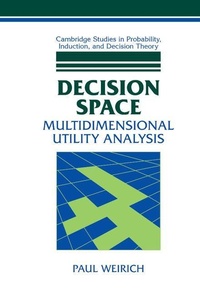
Decision Space
Multidimensional Utility Analysis
Published on 27. August 2001
Book
Hardback
288 pages
978-0-521-80009-9 (ISBN)
Description
In Decision Space: Multidimensional Utility Analysis, first published in 2001, Paul Weirich increases the power and versatility of utility analysis and in the process advances decision theory. Combining traditional and novel methods of option evaluation into one systematic method of analysis, multidimensional utility analysis is a valuable tool. It provides formulations of important decision principles, such as the principle to maximize expected utility; enriches decision theory in solving recalcitrant decision problems; and provides in particular for the cases in which an expert must make a decision for a group of people. The multiple dimensions of this analysis create a decision space broad enough to accommodate all factors affecting an option's utility. The book will be of interest to advanced students and professionals working in the subject of decision theory, as well as to economists and other social scientists.
Reviews / Votes
"Paul Weirich has written an ambitious book that deserves the serious attention of anyone interested in rational choice theory... an important and welcome contribution to the literature..." EthicsMore details
Series
Language
English
Place of publication
Cambridge
United Kingdom
Target group
Professional and scholarly
Illustrations
34 Line drawings, unspecified
Dimensions
Height: 235 mm
Width: 157 mm
Thickness: 20 mm
Weight
571 gr
ISBN-13
978-0-521-80009-9 (9780521800099)
Copyright in bibliographic data and cover images is held by Nielsen Book Services Limited or by the publishers or by their respective licensors: all rights reserved.
Schweitzer Classification
Other editions
Additional editions

Book
07/2007
Cambridge University Press
€70.90
Shipment within 15-20 days
E-Book
01/2005
1st Edition
Cambridge University Press
€48.99
Available for download
Person
Content
List of figures; Preface; 1. Objectives and methods; 2. Intrinsic utility analysis; 3. Expected utility analysis; 4. Expected utility's promotion; 5. Two-dimensional utility analysis; 6. Group utility analysis; 7. Application to trustee decisions; 8. Power and versatility; Appendix: consistency of calculations of utilities; References; Index.