

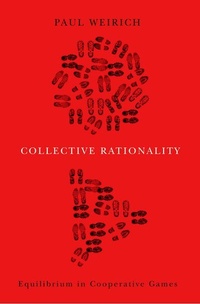
Collective Rationality
Equilibrium in Cooperative Games
Published on 10. December 2009
Book
Hardback
288 pages
978-0-19-538838-1 (ISBN)
Description
Groups of people perform acts that are subject to standards of rationality. A committee may sensibly award fellowships, or may irrationally award them in violation of its own policies. A theory of collective rationality defines collective acts that are evaluable for rationality and formulates principles for their evaluation. This book argues that a group's act is evaluable for rationality if it is the products of acts its members fully control. It also argues that such an act is collectively rational if the acts of the group's members are rational. Efficiency is a goal of collective rationality, but not a requirement, except in cases where conditions are ideal for joint action and agents have rationally prepared for joint action.
The people engaged in a game of strategy form a group, and the combination of their acts yields a collective act. If their collective act is rational, it constitutes a solution to their game. A theory of collective rationality yields principles concerning solutions to games. One principle requires that a solution constitute an equilibrium among the incentives of the agents in the game. In a cooperative game some agents are coalitions of individuals, and it may be impossible for all agents to pursue all incentives. Because rationality is attainable, the appropriate equilibrium standard for cooperative games requires that agents pursue only incentives that provide sufficient reasons to act. The book's theory of collective rationality supports an attainable equilibrium-standard for solutions to cooperative games and shows that its realization follows from individuals' rational acts.
By extending the theory of rationality to groups, this book reveals the characteristics that make an act evaluable for rationality and the way rationality's evaluation of an act responds to the type of control its agent exercises over the act. The book's theory of collective rationality contributes to philosophical projects such as contractarian ethics and to practical projects such as the design of social institutions.
The people engaged in a game of strategy form a group, and the combination of their acts yields a collective act. If their collective act is rational, it constitutes a solution to their game. A theory of collective rationality yields principles concerning solutions to games. One principle requires that a solution constitute an equilibrium among the incentives of the agents in the game. In a cooperative game some agents are coalitions of individuals, and it may be impossible for all agents to pursue all incentives. Because rationality is attainable, the appropriate equilibrium standard for cooperative games requires that agents pursue only incentives that provide sufficient reasons to act. The book's theory of collective rationality supports an attainable equilibrium-standard for solutions to cooperative games and shows that its realization follows from individuals' rational acts.
By extending the theory of rationality to groups, this book reveals the characteristics that make an act evaluable for rationality and the way rationality's evaluation of an act responds to the type of control its agent exercises over the act. The book's theory of collective rationality contributes to philosophical projects such as contractarian ethics and to practical projects such as the design of social institutions.
Reviews / Votes
My overall conclusion is the Weirich's theory of collective rationality is a very precise, internally coherent, and highly impressive contribution to the literature. It deserves to be carefully studied in the years to come. * Notre Dame Philosophical Reviews *More details
Language
English
Place of publication
New York
United States
Target group
College/higher education
Professional and scholarly
Illustrations
9 black and white line illustrations
Dimensions
Height: 155 mm
Width: 236 mm
Thickness: 25 mm
Weight
542 gr
ISBN-13
978-0-19-538838-1 (9780195388381)
Copyright in bibliographic data and cover images is held by Nielsen Book Services Limited or by the publishers or by their respective licensors: all rights reserved.
Schweitzer Classification
Other editions
Additional editions
E-Book
12/2009
OUP eBook
€19.99
Available for download
E-Book
12/2009
1st Edition
OUP eBook
€18.49
Available for download
Person
Paul Weirich is Professor of Philosophy at the University of Missouri.
Content
1. RATIONALITY WRIT LARGE; 2. AGENTS AND ACTS; 3. RATIONALITY; 4. GROUPS; 5. GAMES OF STRATEGY; 6. EQUILIBRIUM; 7. COORDINATION; 8. COOPERATIVE GAMES; 9. STRATEGY FOR COALITIONS; 10. ILLUSTRATIONS AND COMPARISONS; 11. COMPOSITIONALITY; 12. IMPLICATIONS; 12