

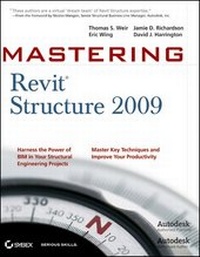
Mastering Revit Structure 2009
1st Edition
Published on 16. December 2008
Book
Paperback/Softback
816 pages
978-0-470-38440-4 (ISBN)
Description
Structure Your Designs the BIM Way
Whether you're a structural engineer, designer, or draftsperson making the move to BIM, you'll dramatically increase productivity and become a Revit Structure expert with the techniques, workflows, and previously undocumented tips and tricks in this thorough reference and tutorial.
The expert authors combine their years of Revit and engineering experience to offer you a solid foundation in Revit Structure concepts, before moving to the structural modeling of such elements as walls, frames, and slabs. You'll learn advanced family creation, standards development, and model documentation and presentation-as well as such crucial topics as annotation, dimensioning, exporting data, 3D visualization, templates, publishing, collaboration, and more. With detailed tutorials and real-world solutions you can implement right away, this is the perfect resource for anyone who wants to master Revit Structure 2009.
Coverage includes:
* Understanding how parametric modeling frees you to focus on your designs
* Exploring the broad array of tools in Revit Structure's user interface
* Viewing and referencing plan, section, elevation, and model views-simultaneously-while you design
* Applying scheduling, annotation, and dimensioning info as you go, for speedier workflows
* Creating and presenting 3D visualizations that bring your designs to life
* Using analytical models to test and simulate, then refine your designs
* Adding custom content and building your own component libraries
* Increase Your Productivity, Speed, and Accuracy with Revit Structure
* Create Dynamic Structural Models Using Best Practices
* Design, Draw, Detail, and Draft in a Virtual World
* Compare Your Designs to Those of Revit Professionals on the Companion Website
* View Striking Revit Structure Examples in the Full-Color Insert
More details
Edition
1., Auflage
Language
English
Place of publication
Chichester
United Kingdom
Publishing group
John Wiley and Sons Ltd
Target group
Professional and scholarly
Illustrations
Illustrations
Dimensions
Height: 23.5 cm
Width: 18.7 cm
Thickness: 44 mm
Weight
1188 gr
ISBN-13
978-0-470-38440-4 (9780470384404)
Schweitzer Classification
Other editions
Additional editions
Thomas E. Weir | Eric Wing | Jamie D. Richardson
Mastering Revit Structure 2009
E-Book
11/2008
Sybex
€42.99
Available for download
Persons
Thomas S. Weir is the Director of BIM and CAD Operations at Brandow & Johnston in Los Angeles. He is President and founder of the L.A. Revit Users Group, moderates the Autodesk User Group International (AUGI) Revit Structural forum, teaches Revit Structure at Autodesk University, and wrote the first Autodesk Official Training Courseware for Revit Structure. Eric Wing has been in the AEC field for fifteen years and has been managing, teaching, and presenting Autodesk applications for ten of them. Eric is AUGI's Autodesk Training Program Director and is also a columnist for AUGI's HotNews monthly newsletter as well as for AUGIWorld magazine. Jamie D. Richardson is an Associate and a CAD/BIM manager for Ericksen Roed & Associates located in the Twin Cities area. He speaks at Autodesk University, is active in his local Revit User Group, and mentors students at local technical colleges. David J. Harrington, former president and former board member of AUGI, is currently a structural designer for Walter P. Moore. He also writes for industry publications, is the technical editor for AUGIWorld magazine, teaches at Autodesk University, and maintains a popular blog (caddhelp.blogspot.com).
Content
Chapter 1: Inside Revit Structure
Chapter 2: Setting the Project Environment
Chapter 3: Starting to Model Your Project
Chapter 4: Columns
Chapter 5: Floors and Roofs
Chapter 6: Walls
Chapter 7: Framing
Chapter 8: Foundations
Chapter 9: Model Documentation
Chapter 10: Modeling Rebar
Chapter 11: Schedules and Quantities
Chapter 12: Sheets, Plotting, Exporting
Chapter 13: Worksharing
Chapter 14: Visualization
Chapter 15: Structural Analytical Model
Chapter 16: Project Phases
Chapter 17: Standards
Chapter 18: Families and Groups
Chapter 19: Advanced Concepts
Chapter 20: Modeling Project Types
Appendix A: Master It solutions
Index