

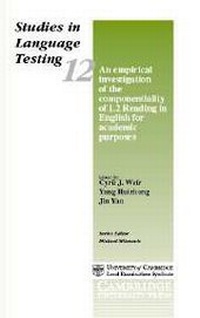
An Empirical Investigation of the Componentiality of L2 Reading in English for Academic Purposes
Published on 7. December 2000
Book
Hardback
288 pages
978-0-521-65299-5 (ISBN)
Description
The focus on careful reading in theoretical literature has meant that we have somewhat ignored reading behaviours such as skimming, scanning and search reading in the teaching and testing of reading. These theories do not explain how readers process texts quickly and selectively. The development of the Advanced English Reading Test (AERT) for university students in the People's Republic of China under the auspices of the National College English Test Committee was the vehicle for investigating the nature of and the relationships between skimming, scanning, search reading and careful reading. This volume reports on the methodological procedures that led to the development of this important test and discusses the results of the empirical investigations that were carried out to establish its validity. As such it offers a blueprint of reading assessment for those wishing to research in the area.
More details
Series
Language
English
Place of publication
Cambridge
United Kingdom
Target group
ELT/ESL
Dimensions
Height: 237 mm
Width: 157 mm
Thickness: 25 mm
Weight
613 gr
ISBN-13
978-0-521-65299-5 (9780521652995)
Copyright in bibliographic data and cover images is held by Nielsen Book Services Limited or by the publishers or by their respective licensors: all rights reserved.
Schweitzer Classification
Other editions
New editions
Cyril Weir | Yang Huizhong | Jin Yan
An Empirical Investigation of the Componentiality of L2 Reading in English for Academic Purposes
Book
12/2000
Cambridge University Press
€88.70
Shipment within 15-20 days
Additional editions
Cyril Weir | Yang Huizhong | Jin Yan
An Empirical Investigation of the Componentiality of L2 Reading in English for Academic Purposes
Book
12/2000
Cambridge University Press
€88.70
Shipment within 15-20 days
Content
1. Introduction; 2. Establishing the parameters of EAP reading; 3. Synthesising the a priori validation; 4. Operationalising the specification: test development; 5. The a posteriori validation of the prototype AERT-version 1; 6. The a posteriori validation of the prototype AERT-version 1: qualitative studies; 7. Conclusions and recommendations.