

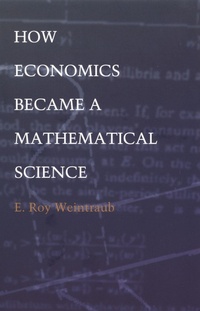
How Economics Became a Mathematical Science
Will be published approx. on 28. May 2002
Book
Hardback
328 pages
978-0-8223-2856-8 (ISBN)
Description
In How Economics Became a Mathematical Science E. Roy Weintraub traces the history of economics through the prism of the history of mathematics in the twentieth century. As mathematics has evolved, so has the image of mathematics, explains Weintraub, such as ideas about the standards for accepting proof, the meaning of rigor, and the nature of the mathematical enterprise itself. He also shows how economics itself has been shaped by economists' changing images of mathematics.
Whereas others have viewed economics as autonomous, Weintraub presents a different picture, one in which changes in mathematics-both within the body of knowledge that constitutes mathematics and in how it is thought of as a discipline and as a type of knowledge-have been intertwined with the evolution of economic thought. Weintraub begins his account with Cambridge University, the intellectual birthplace of modern economics, and examines specifically Alfred Marshall and the Mathematical Tripos examinations-tests in mathematics that were required of all who wished to study economics at Cambridge. He proceeds to interrogate the idea of a rigorous mathematical economics through the connections between particular mathematical economists and mathematicians in each of the decades of the first half of the twentieth century, and thus describes how the mathematical issues of formalism and axiomatization have shaped economics. Finally, How Economics Became a Mathematical Science reconstructs the career of the economist Sidney Weintraub, whose relationship to mathematics is viewed through his relationships with his mathematician brother, Hal, and his mathematician-economist son, the book's author.
Whereas others have viewed economics as autonomous, Weintraub presents a different picture, one in which changes in mathematics-both within the body of knowledge that constitutes mathematics and in how it is thought of as a discipline and as a type of knowledge-have been intertwined with the evolution of economic thought. Weintraub begins his account with Cambridge University, the intellectual birthplace of modern economics, and examines specifically Alfred Marshall and the Mathematical Tripos examinations-tests in mathematics that were required of all who wished to study economics at Cambridge. He proceeds to interrogate the idea of a rigorous mathematical economics through the connections between particular mathematical economists and mathematicians in each of the decades of the first half of the twentieth century, and thus describes how the mathematical issues of formalism and axiomatization have shaped economics. Finally, How Economics Became a Mathematical Science reconstructs the career of the economist Sidney Weintraub, whose relationship to mathematics is viewed through his relationships with his mathematician brother, Hal, and his mathematician-economist son, the book's author.
Reviews / Votes
"Roy Weintraub retells the history of twentieth-century economics through a series of engagements-duels of intellect and imagination-between individual members of two scientific communities: the mathematicians and the economists. A totally original, idiosyncratic, and highly personal account which illuminates brilliantly not just how economics became mathematized, but how mathematics cut free from the objects of science."-Mary S. Morgan, London School of Economics and University of Amsterdam "The mathematization of economics is probably the most important development in the history of twentieth-century economics. This book provides fascinating accounts of important episodes in this process and should interest anyone who wants to understand how and why it took place."-Roger Backhouse, University of BirminghamMore details
Series
Language
English
Place of publication
North Carolina
United States
Target group
Professional and scholarly
Product notice
Cloth over boards
Illustrations
6 b&w photos
Dimensions
Height: 242 mm
Width: 161 mm
Thickness: 30 mm
Weight
726 gr
ISBN-13
978-0-8223-2856-8 (9780822328568)
Copyright in bibliographic data and cover images is held by Nielsen Book Services Limited or by the publishers or by their respective licensors: all rights reserved.
Schweitzer Classification
Other editions
Additional editions
E. Roy Weintraub | Barbara Herrnstein Smith
How Economics Became a Mathematical Science
E-Book
05/2002
1st Edition
De Gruyter
€208.99
Available for download
Person
E. Roy Weintraub is Professor of Economics at Duke University. He is the editor of Toward a History of Game Theory, also published by Duke University Press, and the author of numerous books, including Stabilizing Dynamics: Constructing Economic Knowledge.
Content
Acknowledgments
Prologue
1. Burn the Mathematics (Tripos)
2. The Marginalization of Griffith C. Evans
3. Whose Hilbert?
4. Bourbaki and Debreu
5. Negotiating at the Boundary (with Ted Gayer)
6. Equilibrium Proofmaking (with Ted Gayer)
7. Sidney and Hal
8. From Bleeding Hearts to Desiccated Robots
9. Body, Image, Person
Notes
Bibliography
Index
Prologue
1. Burn the Mathematics (Tripos)
2. The Marginalization of Griffith C. Evans
3. Whose Hilbert?
4. Bourbaki and Debreu
5. Negotiating at the Boundary (with Ted Gayer)
6. Equilibrium Proofmaking (with Ted Gayer)
7. Sidney and Hal
8. From Bleeding Hearts to Desiccated Robots
9. Body, Image, Person
Notes
Bibliography
Index