

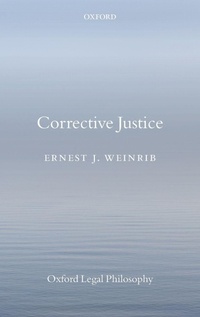
Corrective Justice
Published on 20. September 2012
Book
Hardback
366 pages
978-0-19-966064-3 (ISBN)
Description
Private law governs our most pervasive relationships with other people: the wrongs we do to one another, the property we own and exclude from others' use, the contracts we make and break, and the benefits realized at another's expense that we cannot justly retain. The major rules of private law are well known, but how they are organized, explained, and justified is a matter of fierce debate by lawyers, economists, and philosophers.
Ernest Weinrib made a seminal contribution to the understanding of private law with his first book, The Idea of Private Law. In it, he argued that there is a special morality intrinsic to private law: the morality of corrective justice. By understanding the nature of corrective justice we understand the purpose of private law - which is simply to be private law.
In this new book Weinrib takes up and develops his account of corrective justice, its nature, and its role in understanding the law. He begins by setting out the conceptual components of corrective justice, drawing a model of a moral relationship between two equals and the rights and duties that exist between them. He then explains the significance of corrective justice for various legal contexts: for the grounds of liability in negligence, contract, and unjust enrichment; for the relationship between right and remedy; for legal education; for the comparative understanding of private law; and for the compatibility of corrective justice with state support for the poor.
Combining legal and philosophical analysis, Corrective Justice integrates a concrete and wide-ranging treatment of legal doctrine with a unitary and comprehensive set of theoretical ideas. Alongside the revised edition of The Idea of Private Law, it will be essential reading for all academics, lawyers, and students engaged in understanding the foundations of private law.
Ernest Weinrib made a seminal contribution to the understanding of private law with his first book, The Idea of Private Law. In it, he argued that there is a special morality intrinsic to private law: the morality of corrective justice. By understanding the nature of corrective justice we understand the purpose of private law - which is simply to be private law.
In this new book Weinrib takes up and develops his account of corrective justice, its nature, and its role in understanding the law. He begins by setting out the conceptual components of corrective justice, drawing a model of a moral relationship between two equals and the rights and duties that exist between them. He then explains the significance of corrective justice for various legal contexts: for the grounds of liability in negligence, contract, and unjust enrichment; for the relationship between right and remedy; for legal education; for the comparative understanding of private law; and for the compatibility of corrective justice with state support for the poor.
Combining legal and philosophical analysis, Corrective Justice integrates a concrete and wide-ranging treatment of legal doctrine with a unitary and comprehensive set of theoretical ideas. Alongside the revised edition of The Idea of Private Law, it will be essential reading for all academics, lawyers, and students engaged in understanding the foundations of private law.
Reviews / Votes
Weinreb continues to build a compelling case that the character and aspirations of private law are best understood as manifestations of a normative ideal that is sensitive to the structure of private law reasoning and liability, and that 'works backward from the doctrines and institutions of private law to the most pervasive abstractions in it' (p.26). In my view it is a wonderful book. * Andrew Botterell, Mind Association * His latest book - Corrective Justice - is exceptional precisely because Weinrib is deeply informed about legal doctrine. Of course, he also has formidable philosophical skill, and in bringing that to bear on doctrine, he dismantles any thought that corrective justice is too abstract a concept to shed light on the practical problems that courts face. Along the way, he also demolishes the instrumentalism that has recently dominated scholarship about private law. * Scott Hershovitz, Law and Philosophy d *More details
Series
Language
English
Place of publication
Oxford
United Kingdom
Target group
Professional and scholarly
Dimensions
Height: 240 mm
Width: 161 mm
Thickness: 24 mm
Weight
713 gr
ISBN-13
978-0-19-966064-3 (9780199660643)
Copyright in bibliographic data and cover images is held by Nielsen Book Services Limited or by the publishers or by their respective licensors: all rights reserved.
Schweitzer Classification
Other editions
Additional editions
Ernest J. Weinrib
Corrective Justice
Book
08/2016
Oxford University Press
€41.52
Shipment within 15-20 days
Ernest J. Weinrib
Corrective Justice
E-Book
09/2012
1st Edition
Oxford University Press
€104.86
Available for download
Ernest J. Weinrib
Corrective Justice
E-Book
09/2012
1st Edition
OUP Oxford
€12.09
Available for download
Person
A native of Toronto, Ernest Weinrib has a PhD from Harvard (1968) and a BA (1965) and a JD (1972) from the University of Toronto. He has been teaching law at the University of Toronto since 1972, and has been a visiting professor at the Yale Law School and at Tel Aviv University. He holds the rank of University Professor (the University of Toronto's highest honour) and is the Cecil A. Wright Professor of Law.
Content
Introduction ; 1. Correlativity and Personality ; 2. The Disintegration of Duty ; 3. Remedies ; 4. Gain-based Damages ; 5. Punishment and Disgorgement as Contract Remedies ; 6. Unjust Enrichment ; 7. Incontrovertible Benefit in Jewish Law ; 8. Poverty and Property in Kant's System of Rights ; 9. Can Law Survive Legal Education? ; Conclusion