

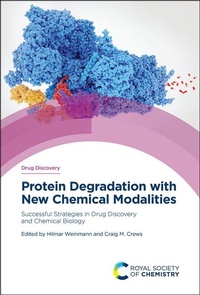
Protein Degradation with New Chemical Modalities
Successful Strategies in Drug Discovery and Chemical Biology
Published on 8. October 2020
Book
Hardback
380 pages
978-1-78801-686-5 (ISBN)
Description
Targeting protein degradation using small molecules is one of the most exciting small-molecule therapeutic strategies in decades and a rapidly growing area of research. In particular, the development of proteolysis targeting chimera (PROTACs) as potential drugs capable of recruiting target proteins to the cellular quality control machinery for elimination has opened new avenues to address traditionally 'difficult to target' proteins. This book provides a comprehensive overview from the leading academic and industrial experts on recent developments, scope and limitations in this dynamically growing research area; an ideal reference work for researchers in drug discovery and chemical biology as well as advanced students.
More details
Series
Language
English
Place of publication
Cambridge
United Kingdom
Target group
College/higher education
Product notice
Unsewn / adhesive bound
Dimensions
Height: 235 mm
Width: 159 mm
Thickness: 25 mm
Weight
734 gr
ISBN-13
978-1-78801-686-5 (9781788016865)
DOI
10.1039/9781839160691
Copyright in bibliographic data and cover images is held by Nielsen Book Services Limited or by the publishers or by their respective licensors: all rights reserved.
Schweitzer Classification
Other editions
Additional editions
Hilmar Weinmann | Craig Crews
Protein Degradation with New Chemical Modalities
Successful Strategies in Drug Discovery and Chemical Biology
E-Book
10/2020
1st Edition
Royal Society of Chemistry
€248.99
Available for download
Hilmar Weinmann | Craig Crews
Protein Degradation with New Chemical Modalities
Successful Strategies in Drug Discovery and Chemical Biology
E-Book
10/2020
1st Edition
Royal Society of Chemistry
€248.99
Available for download
Persons
Content
PROTAC-mediated Target Degradation: A Paradigm Changer in Drug Discovery?;
Structural and Biophysical Principles of Degrader Ternary Complexes;
Immediate and Selective Control of Protein Abundance using the dTAG System;
Developing Pharmacokinetic/Pharmacodynamic Relationships with PROTACs;
New Activities of CELMoDs, Cereblon E3 Ligase Modulating Drugs;
Structure-based PROTACs Design;
Plate-Based High Throughput Cellular Degradation Assays to Identify PROTACS Molecules and Protein Degraders;
PROTAC Targeting BTK for the Treatment of Ibrutinib-Resistant B-Cell Malignancies;
An Efficient Approach Toward Drugging Undruggable Targets;
E3-Mediated Ubiquitin and Ubiquitin-like Protein Ligation: Mechanisms and Chemical Probes;
Plant E3 Ligases as Versatile Tools for Novel Drug Development and Plant Bioengineering;
Deubiquitinase Inhibitors: An Emerging Therapeutic Class;
Targeting Translation Regulation for the Development of Novel Drugs;
Classes, Modes-of-action and Selection of New Modalities in Drug Discovery;
Small Molecule Targeted Degradation of RNA
Structural and Biophysical Principles of Degrader Ternary Complexes;
Immediate and Selective Control of Protein Abundance using the dTAG System;
Developing Pharmacokinetic/Pharmacodynamic Relationships with PROTACs;
New Activities of CELMoDs, Cereblon E3 Ligase Modulating Drugs;
Structure-based PROTACs Design;
Plate-Based High Throughput Cellular Degradation Assays to Identify PROTACS Molecules and Protein Degraders;
PROTAC Targeting BTK for the Treatment of Ibrutinib-Resistant B-Cell Malignancies;
An Efficient Approach Toward Drugging Undruggable Targets;
E3-Mediated Ubiquitin and Ubiquitin-like Protein Ligation: Mechanisms and Chemical Probes;
Plant E3 Ligases as Versatile Tools for Novel Drug Development and Plant Bioengineering;
Deubiquitinase Inhibitors: An Emerging Therapeutic Class;
Targeting Translation Regulation for the Development of Novel Drugs;
Classes, Modes-of-action and Selection of New Modalities in Drug Discovery;
Small Molecule Targeted Degradation of RNA