

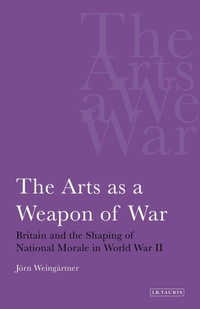
The Arts as a Weapon of War
Britain and the Shaping of National Morale in World War II
Published on 8. June 2012
Book
Paperback/Softback
248 pages
978-1-78076-032-2 (ISBN)
Description
In 1834, Lord Melbourne spoke the words that epitomised the British government's attitude towards its own involvement in the arts: 'God help the minister that meddles with Art'. However, with the outbreak of World War II, that attitude changed dramatically when 'cultural policy' became a key element of the domestic front. Not only a propaganda tool, it aimed to boost morale and prevent a wartime cultural blackout. "The Arts as a Weapon of War" traces the evolution of this policy from the creation of the Committee for the Encouragement of Music and the Arts, in 1939, to the drafting of the Arts Council's constitution in 1945. From the improvement of the National Gallery to Myra Hess' legendary concerts during the blitz, Jorn Weingartner provides a fascinating account of the powerful policy shift that laid the foundations for the modern relationship between government and the arts.
More details
Language
English
Place of publication
United Kingdom
Publishing group
Bloomsbury Publishing PLC
Product notice
Paperback (trade)
Dimensions
Height: 216 mm
Width: 140 mm
Thickness: 13 mm
Weight
293 gr
ISBN-13
978-1-78076-032-2 (9781780760322)
Copyright in bibliographic data and cover images is held by Nielsen Book Services Limited or by the publishers or by their respective licensors: all rights reserved.
Schweitzer Classification
Other editions
Additional editions
Jorn Weingartner
The Arts as a Weapon of War
Britain and the Shaping of National Morale in World War II
E-Book
06/2012
1st Edition
I.B. Tauris
€41.99
Available for download
Jorn Weingartner
The Arts as a Weapon of War
Britain and the Shaping of National Morale in World War II
E-Book
06/2012
I.B. Tauris
€41.99
Available for download
Person
Jorn Weingartner holds a PhD in History from the University of Hamburg, Germany, and is a Senior Officer of the German National Academic Foundation.
Content
I. Introduction
II. The political reasons for state neutrality in the sphere of arts in Great Britain
III. The cultural elites and state intervention
IV. Indicators of extended state influence on the arts
V. The Cultural Blackout and the Phase of the 'Welfarist Approach'
VI. John Meynard Keynes and the 'standard approach': CEMA's policy from January 1942 to September 1944
VII. From CEMA to the Arts Council of Great Britain, September 1944 to June 1945 and beyond
VIII. Conclusion and Outlook
II. The political reasons for state neutrality in the sphere of arts in Great Britain
III. The cultural elites and state intervention
IV. Indicators of extended state influence on the arts
V. The Cultural Blackout and the Phase of the 'Welfarist Approach'
VI. John Meynard Keynes and the 'standard approach': CEMA's policy from January 1942 to September 1944
VII. From CEMA to the Arts Council of Great Britain, September 1944 to June 1945 and beyond
VIII. Conclusion and Outlook