

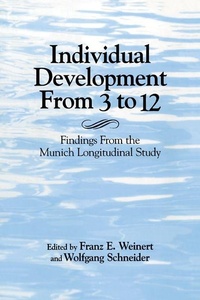
Individual Development from 3 to 12
Findings from the Munich Longitudinal Study
Published on 3. March 2011
Book
Paperback/Softback
372 pages
978-0-521-17634-7 (ISBN)
Description
This book describes the findings of a longitudinal study conducted with about 200 children from 1984 to 1993. Children were recruited for the study when they had just entered kindergarten at the age of about 4 years. The study aimed to investigate changes in cognitive, social, and personality development over the preschool and elementary school years. One of the unique features of this longitudinal study is that relationships and interactions among cognitive, social, and personality development could be assessed based on the data of a representative sample of children.
Reviews / Votes
"...this is an excellent book. It provides a unique longitudinal perspective on childhood development that is unrivaled. Any developmental psychologist will want to read this volume." Robert J. Sternberg, Human DevelopmentMore details
Language
English
Place of publication
Cambridge
United Kingdom
Target group
Professional and scholarly
Product notice
Paperback (trade)
Illustrations
Worked examples or Exercises
Dimensions
Height: 229 mm
Width: 152 mm
Thickness: 22 mm
Weight
603 gr
ISBN-13
978-0-521-17634-7 (9780521176347)
Copyright in bibliographic data and cover images is held by Nielsen Book Services Limited or by the publishers or by their respective licensors: all rights reserved.
Schweitzer Classification
Other editions
Additional editions

Franz E. Weinert | Wolfgang Schneider
Individual Development from 3 to 12
Findings from the Munich Longitudinal Study
Book
01/1999
Cambridge University Press
€143.30
Shipment within 15-20 days
Persons
Content
1. Logic: introduction and overview Franz E. Weinert, Wolfgang Schneider, Jan Stefanek and Angelika Weber; 2. The development of intelligence and thinking Wolfgang Schneider, Josef Perner, Merry Bullock, Jan Stefanek and Albert Ziegler; 2a. What individual differences can teach us about developmental function, and vice versa David F. Bjorklund; 3. Scientific reasoning: developmental and individual differences Merry Bullock and Albert Ziegler; 3a. Comments on 'scientific' reasoning: developmental and individual differences David Klahr; 4. Memory strategy development: gradual increase, sudden insight, or roller coaster Beate Sodian and Wolfgang Schneider; 4a. Toward an understanding of the development of memory: comments on the chapters by Sodian and Schneider and by Weber and Strube; 5. Memory for events experienced and events observed Angelika Weber and Gerhard Strube; 6. The development of memory for texts Monika Knopf; 6a. Developmental trends in story recall Walter Kintsch; 7. The impact of early phonological processing skills on reading and spelling in school: evidence from the Munich Longitudinal Study Wolfgang Schneider and Jan Carol Naeslund; 7a. Sound logic Peter Bryant; 8. Development of mathematical competencies Elsbeth Stern; 8a. Commentary on development of mathematical competencies Susan R. Goldman and James W. Pellegrino; 9. Schooling and the development of achievement differences Andreas Helmke and Franz C. Weinert; 9a. Schooling and the development of achievement differences Richard E. Snow; 10. From optimism to realism?: development of children's academic self-concept from Kindergarten to Grade 6 Andreas Helmke; 10a. The logic and meaning of declining perceptions of academic competence Deborah Stipek; 11. Social-personality development Jens B. Asendorpf; 11a. Contributions to knowledge about social-personality development: the Munich Logic Study Kenneth R. Rubin; 12. The development of moral understanding and moral motivation Gertrud Nunner-Winkler; 12a. Caring about morality: the development of moral motivation in Nunner-Winkler's work Augusto Blasi; 13. A person-centered approach to development: the temporal consistency of personality and self-concept Marcel A. G. Van Aken and Jens B. Asendorpf; 13a. Regarding 'a person-centered approach to development Jack Block; 14. Universal, differential and individual aspects of child development from 3 to 12: what can we learn from a comprehensive longitudinal study? Franz E. Weinert, Merry Bullock and Wolfgang Schneider; References; Index.