

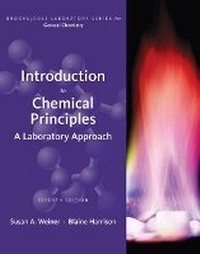
Introduction to Chemical Principles
A Laboratory Approach
7th Edition
Published on 27. January 2009
Book
Paperback/Softback
480 pages
978-0-495-11479-6 (ISBN)
Description
Don't go to the lab without it! INTRODUCTION TO CHEMICAL PRINCIPLES: A LABORATORY APPROACH teaches you to collect and analyze experimental data with ease using 36 class-tested experiments. Work Pages and Report Sheets for each experiment offer a convenient and efficient way for you to record your data as you work. Advance Study Assignments, Sample Calculations, and laboratory and safety procedures are just a few of the tools that will help you complete your lab experiments successfully.
More details
Edition
7th edition
Language
English
Place of publication
CA
United States
Publishing group
Cengage Learning, Inc
Target group
College/higher education
Dimensions
Height: 30 mm
Width: 213 mm
Thickness: 269 mm
Weight
1111 gr
ISBN-13
978-0-495-11479-6 (9780495114796)
Copyright in bibliographic data and cover images is held by Nielsen Book Services Limited or by the publishers or by their respective licensors: all rights reserved.
Schweitzer Classification
Persons
Susan Weiner was born in Hungary and moved to the United States in 1957, after receiving her Bachelor of Science in Chemical Engineering from the Technical University in Hungary. She earned a Master's of Science in Chemistry from New York University, and worked in research at the New York University Medical School, the University of California, Berkeley, and for the Dow Chemical Company. She is the author of more than twenty publications for various professional journals on Sea Water Conversion and currently teaches at West Valley College, where she served for many years as the Chemistry Department chair. Also an instrument rated pilot, Weiner enjoys flying and spending time with her twin granddaughters. Dr. Blaine Harrison is a professor of Introductory and Organic Chemistry at West Valley College in Saratoga, CA. He received his B.S. in Biochemistry from Cal Poly San Luis Obispo in 1989 and his Ph.D in Organic Chemistry from UC Santa Cruz in 1998.
Content
SAFETY IN THE LABORATORY.
LABORATORY PROCEDURES.
EXPERIMENTS:
1. Properties and Changes of Matter (m).
2. The Chemistry of Some Household Products.
3. Separation of Cations by Paper Chromatography (m).
4. Densities of Liquids and Solids.
5. Simplest Formula of a Compound (m).
6. Hydrates (m).
7. Percentage of Oxygen in Potassium Chlorate.
8. Calorimetry.
9. Chemical Names and Formulas: A Study Assignment.
10. Chemical Equations: A Study Assignment.
11. Mole Ratio for a Chemical Reaction (m).
12. Types of Chemical Reactions (m).
13. Qualitative Analysis of Some Common Ions (m).
14. Separation of Cations.
15. Molecular Models: A Study Assignment.
16. Molar Volume of a Gas (m).
17. Molar Mass Determination by Freezing-Point Depression.
18. The Conductivity of Solutions: A Demonstration.
19. Net Ionic Equations: A Study Assignment.
20. Titration of Acids and Bases-I.
21. Titration of Acids and Bases-II.
22. Determination of a Chemical Equation.
23. A Study of Reaction Rates.
24. Chemical Equilibrium (m).
25. Measurement of pH with Indicators.
26. Introduction to Oxidation-Reduction Reactions (m).
27. Organic Nomenclature.
28. Hydrocarbons and Alcohols.
29. Aldehydes, Ketones, and Carboxylic Acids.
30. Esters.
31. Preparation of Aspirin.
32. Preparation and Properties of a Soap.
33. Carbohydrates.
34. Lipids.
35. Amino Acids and Proteins.
36. Enzymes.
WORKSHEETS:
1. Significant Figures.
2. Dimensional Analysis.
3. Avogrado's Number-Moles.
4. Formula Writing.
5. Equation Balancing-Types of Reactions.
6. Stoichiometry.
7. Atomic Structure.
8. Gases.
9. Solutions.
10. Oxidation-Reduction.
11. Acids and Bases.
Appendix.
LABORATORY PROCEDURES.
EXPERIMENTS:
1. Properties and Changes of Matter (m).
2. The Chemistry of Some Household Products.
3. Separation of Cations by Paper Chromatography (m).
4. Densities of Liquids and Solids.
5. Simplest Formula of a Compound (m).
6. Hydrates (m).
7. Percentage of Oxygen in Potassium Chlorate.
8. Calorimetry.
9. Chemical Names and Formulas: A Study Assignment.
10. Chemical Equations: A Study Assignment.
11. Mole Ratio for a Chemical Reaction (m).
12. Types of Chemical Reactions (m).
13. Qualitative Analysis of Some Common Ions (m).
14. Separation of Cations.
15. Molecular Models: A Study Assignment.
16. Molar Volume of a Gas (m).
17. Molar Mass Determination by Freezing-Point Depression.
18. The Conductivity of Solutions: A Demonstration.
19. Net Ionic Equations: A Study Assignment.
20. Titration of Acids and Bases-I.
21. Titration of Acids and Bases-II.
22. Determination of a Chemical Equation.
23. A Study of Reaction Rates.
24. Chemical Equilibrium (m).
25. Measurement of pH with Indicators.
26. Introduction to Oxidation-Reduction Reactions (m).
27. Organic Nomenclature.
28. Hydrocarbons and Alcohols.
29. Aldehydes, Ketones, and Carboxylic Acids.
30. Esters.
31. Preparation of Aspirin.
32. Preparation and Properties of a Soap.
33. Carbohydrates.
34. Lipids.
35. Amino Acids and Proteins.
36. Enzymes.
WORKSHEETS:
1. Significant Figures.
2. Dimensional Analysis.
3. Avogrado's Number-Moles.
4. Formula Writing.
5. Equation Balancing-Types of Reactions.
6. Stoichiometry.
7. Atomic Structure.
8. Gases.
9. Solutions.
10. Oxidation-Reduction.
11. Acids and Bases.
Appendix.