

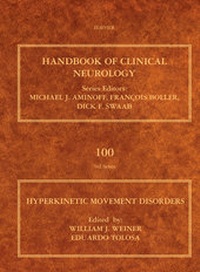
Hyperkinetic Movement Disorders: Volume 100
Volume 100
Published on 23. May 2011
Book
Hardback
768 pages
978-0-444-52014-2 (ISBN)
Description
The Handbook of Clinical Neurology Vol 100: Hyperkinetic Movement Disorders discusses hyperkinetic disorders related mainly to basal ganglia dysfunction and pathology. It contains 13 sections and 51 chapters written by authoritative and experienced investigators and clinicians in this extremely broad and diverse group of diseases and syndromes.
The first section on choreoathetoid diseases and syndromes includes chapters on Huntington's disease and Huntington's disease look-alikes; spinocerebellar degenerations; neuroacanthocytosis; entatorubral-pallidoluysian atrophy; neuroferritinopathy; neurodegeneration with brain iron accumulation; mitochondrial disorders; acquired hepatocerebral degeneration; benign hereditary chorea; and "senile chorea.? The remaining chapters focus on the abnormal involuntary movements associated with each disease or syndrome. These include immune-related chorea, vascular chorea, metabolic disturbances that can induce chorea, chorea in other medical settings (e.g., postpump chorea in children, cancer-related paraneoplastic syndromes), myoclonus, essential tremor, and dystonia, including dystonia plus syndromes. There are also chapters on tardive dyskinesia, unusual clinical syndromes, and tics and stereotyped movements in children.
The text is a valuable resource for neurology and psychiatry residents, practicing neurologists and psychiatrists, and specialists in movement disorders.
The first section on choreoathetoid diseases and syndromes includes chapters on Huntington's disease and Huntington's disease look-alikes; spinocerebellar degenerations; neuroacanthocytosis; entatorubral-pallidoluysian atrophy; neuroferritinopathy; neurodegeneration with brain iron accumulation; mitochondrial disorders; acquired hepatocerebral degeneration; benign hereditary chorea; and "senile chorea.? The remaining chapters focus on the abnormal involuntary movements associated with each disease or syndrome. These include immune-related chorea, vascular chorea, metabolic disturbances that can induce chorea, chorea in other medical settings (e.g., postpump chorea in children, cancer-related paraneoplastic syndromes), myoclonus, essential tremor, and dystonia, including dystonia plus syndromes. There are also chapters on tardive dyskinesia, unusual clinical syndromes, and tics and stereotyped movements in children.
The text is a valuable resource for neurology and psychiatry residents, practicing neurologists and psychiatrists, and specialists in movement disorders.
More details
Series
Language
English
Place of publication
Oxford
United Kingdom
Publishing group
Elsevier Science & Technology
Target group
Professional and scholarly
Neurologists
Neuroscience research workers
Product notice
sewn/stitched
Cloth over boards
Illustrations
Approx. 152 illustrations (48 in full color)
Dimensions
Height: 260 mm
Width: 195 mm
Thickness: 42 mm
Weight
2320 gr
ISBN-13
978-0-444-52014-2 (9780444520142)
Copyright in bibliographic data and cover images is held by Nielsen Book Services Limited or by the publishers or by their respective licensors: all rights reserved.
Schweitzer Classification
Other editions
Additional editions
William J. Weiner MD | Eduardo Tolosa MD
Hyperkinetic Movement Disorders
E-Book
05/2012
Elsevier
€220.00
Available for download
Persons
Content
SECTION 1 - Choreoathetoid Diseases and Syndromes
SECTION 2 - Immune Related Chorea
SECTION 3 - Vascular Related Chorea
SECTION 4 - Metabolic Disturbances
SECTION 5 - Chorea in Other Medical Settings
SECTION 6 - Other Syndromes
SECTION 7 - Athetosis
SECTION 8 - Myoclonus
SECTION 9 - Essential Tremor
SECTION 10 - Dystonia
SECTION 11 - Tardive Dyskinesia
SECTION 12 - Tics
SECTION 13 - Other Syndromes
SECTION 2 - Immune Related Chorea
SECTION 3 - Vascular Related Chorea
SECTION 4 - Metabolic Disturbances
SECTION 5 - Chorea in Other Medical Settings
SECTION 6 - Other Syndromes
SECTION 7 - Athetosis
SECTION 8 - Myoclonus
SECTION 9 - Essential Tremor
SECTION 10 - Dystonia
SECTION 11 - Tardive Dyskinesia
SECTION 12 - Tics
SECTION 13 - Other Syndromes