

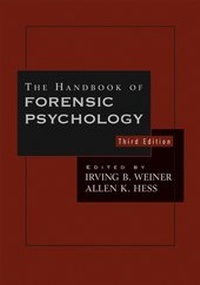
The Handbook of Forensic Psychology
3rd Edition
Published on 1. October 2005
Book
Hardback
912 pages
978-0-471-69232-4 (ISBN)
Description
This is a fully-revised and updated version of the top academic work in forensic psychology. Focussed mainly on the practical aspects of forensics, this volume provides all readers need to know to be effective practioners. Detailed sections cover both civil and criminal forensic practice; forensic report writing; treating mental illness in the incarcerated; andethicsal issues. Contributors are the best-known and most respected practitioners in the field from the US and Canada. All chapters are completely revised from the previous edition, including 6 which have new authors. Forensic psychology is one of the fastest-growing specialties in the field. Its practitioners are able to avoid managed care and structured settings, and they often focus on assessment, rather than long-term treatment of clients. With the growing public interest in all things forensic, most graduate programs in psychology have added at least one course in forensic psychology over the past few years; and more established professionals are entering the field every day.
More details
Edition
3., Auflage
Language
English
Place of publication
New York
United States
Publishing group
John Wiley and Sons Ltd
Target group
Professional and scholarly
Edition type
Revised edition
Illustrations
Illustrations
Dimensions
Height: 26 cm
Width: 18.7 cm
Thickness: 36 mm
Weight
1570 gr
ISBN-13
978-0-471-69232-4 (9780471692324)
Schweitzer Classification
Other editions
New editions
Irving B. Weiner | Randy K. Otto
The Handbook of Forensic Psychology
Book
01/2014
4th Edition
Wiley
€166.50
Article not available at the moment
Previous edition
Allen K. Hess | Irving B. Weiner
The Handbook of Forensic Psychology
Book
11/1998
2nd Edition
Wiley
€139.00
Article exhausted; check for reprint
Persons
Irving Weiner (Tampa, FL) is the chairmain of the psychology department at the University of South Florida. He is the author of numerous books, and is the editor of the award-winning 12 volume Handbook of Psychology. Dr. Weiner is the chairman of the Wiley Behavioral Sciences Advisory Board. Allen K. Hess (Montgomery, AL) is a professor of psychology at Auburn University. He is the author, among other books, of the classic text Psychotherapy Supervision: Theory, Practice and Research.
Content
PART ONE: THE CONTEXT OF FORENSIC PSYCHOLOGY.
1. History of Forensic Psychology (Curt R. Bartol and Anne M. Bartol).
2. Defining Forensic Psychology (Allen K. Hess).
3. Legal Research for the Social Scientist (Tyler L. Cox)
PART TWO: APPLYING PSYCHOLOGY TO CIVIL PROCEEDINGS.
4. Understanding Adult Domestic Law Issues: Marriage, Divorce, and Domestic Violence (Kathryn D. Hess).
5. Understanding Child Domestic Law Issues: Custody, Adoptions, and Abuse (Kathryn D. Hess).
6. Conducting Personal Injury Evaluations (Steven Walfish).
7. Personality Assessment in Personal Injury Litigation (James N. Butcher and Kathryn B. Miller).
8. Legal Influences on the Identification and Treatment of Educational Disabilities (Daniel J. Reschly).
9. Civil Competency (Ralph Slovenko).
10. Informed Consent in Treatment and Research (Barbara Stanley and Michelle Galietta).
PART THREE: APPLYING PSYCHOLOGY TO CRIMINAL PROCEEDINGS.
11. Evaluating Eyewitness Testimony in Adults and Children (Paola Castelli, Gail S. Goodman, Robin S. Edelstein, Emilie B. Mitchell, Pedro M. Paz Alonso, Kristen E. Lyons, and Jeremy W. Newton).
12. Competency To Stand Trial: A Guide for Evaluators (Patricia A. Zapf and Ronald Roesch).
13. Criminal Responsibility and the Insanity Defense (Patricia A. Zapf, Stephen L. Golding, and Ronald Roesch).
14. Specific Intent and Diminished Capacity (Charles R. Clark).
15. Evaluating and Assisting Jury Competence in Civil Cases (Jennifer K. Robbennolt, Jennifer L. Groscup, and Steven Penrod).
16. Recommending Probation and Parole (David Nussbaum).
PART FOUR: SPECIAL APPLICATIONS.
17. Violence Risk Assessments: Research, Legal, and Clinical Considerations (Thomas R. Litwack, Patricia A. Zapf, Jennifer L. Groscup, and Stephen D. Hart).
18. Psychology and Law Enforcement (Ellen Scrivner).
19. Polygraph ("Lie Detector") Testing: Current Status and Emerging Trends (William G. Iacono and Christopher J. Patrick).
20. Forensic Uses of Hypnosis (Alan W. Scheflin).
PART FIVE: COMMUNICATION EXPERT OPINIONS.
21. Writing Forensic Reports (Irving B. Weiner).
22. Serving As an Expert Witness (Allen K. Hess).
PART SIX: INTERVENING WITH OFFENDERS.
23. Punishments and Alternate Routes to Crime Prevention (Joan McCord)
24. Practicing Psychology in Correctional Settings (Paul Gendreau, Claire Goggin, and Sheila French ).
25. Psychotherapy With Criminal Offenders (Max J. Mobley).
26. Diagnosis and Treatment of Sexual Offenders (William J. Marshall).
PART SEVEN: PROFESSIONAL ISSUES.
27. Practicing Principled Forensic Psychology: Legal, Ethical, and Moral Considerations (Allen K. Hess).
28. Training in Forensic Psychology: Training for What Goal? ( David A. Krauss and Bruce D. Sales).