

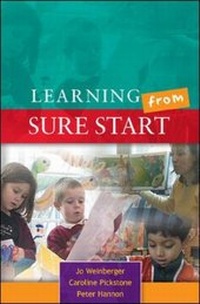
Learning from Sure Start
Published on 16. July 2005
Book
Hardback
304 pages
978-0-335-21639-0 (ISBN)
Description
?Which are the key issues to emerge from the innovative work of Sure Start, in the development of new ways of working for the benefit of young children? ?What are the implications of the development of inter-agency theory and practice for the planning and delivery of services for children? ?What does the work being developed through Sure Start have to contribute to the future development of services for children in the UK for the next decade and beyond? The book comes out of a University research project that has worked closely with one local programme over five years from its beginning. Sure Start is a national government initiative that targets families with children aged up to the age of four in areas of social and economic disadvantage, to promote development so children are ready to thrive when they start school. Latterly, there has been increased emphasis on day care to enable parents to join the workforce. The particular Sure Start programme at Foxhill & Parson Cross in Sheffield provided the framework for a wide range of new services within health, education and social services and allowed for innovative practice and inter-agency collaboration. Those involved in the programme provide accounts of these various services, what methods were employed, what worked and what didn't work, and lessons that can be drawn from their experience that may be helpful for other situations. The implications of this work extend far beyond the immediate context of this particular programme.
More details
Language
English
Place of publication
Milton Keynes
United Kingdom
Illustrations
Illustrations
Dimensions
Height: 236 mm
Width: 157 mm
Thickness: 22 mm
Weight
607 gr
ISBN-13
978-0-335-21639-0 (9780335216390)
Copyright in bibliographic data and cover images is held by Nielsen Book Services Limited or by the publishers or by their respective licensors: all rights reserved.
Schweitzer Classification
Persons
Edited by Jo Weinberger, Caroline Pickstone and Peter Hannon Jo Weinberger is a Senior Research Fellow at Sheffield University and has worked on research and evaluation in the Foxhill & Parson Cross Sure Start initiative for over two years. She has previously worked as a lecturer, researcher, nursery teacher and community worker focusing on home school reading development. Her book on early literacy in a home and community context, Literacy Goes to School, was published in 1996. Caroline Pickstone is a Research Fellow and Honorary Clinical Lecturer in the University of Sheffield and has worked with Foxhill & Parson Cross Sure Start on a research study since 2000. She is an experienced Speech & Language Therapist and manager and has been involved with the development of new working models for children services. She has published research articles in Child Care Health and Development and Child Language Teaching and Therapy as well as within professional journals. Peter Hannon is Professor of Education, University of Sheffield. His work is principally in early childhood education and literacy. He is responsible, with the programme manager, for the coordination of research and evaluation into the Foxhill and Parson Cross Sure Start programme. He is the author of numerous research publications on young children and their families including two books: Literacy, Home and School (1995) and Reflecting on Literacy in Education (2000). Contributors * Susan Battersby * Robin Carlisle * Deborah Crofts * Margaret Drake * Fiona Ford * Linda Fox * Imogen Hale * Peter Hannon * Helen Lomas * Jackie Marsh * Anne Morgan * Simon Martinez * Caroline Pickstone * Ann Rowe * Jo Weinberger
Content
Foreword: Naomi Eisenstadt, Director of Sure Start, Department for Education & Skills Details of contributors
Part 1: Introduction:
Chapter 1: Why we should learn from Sure Start
Chapter 2: Listening to families: a survey of parents' views
Part 2: Improving social and emotional development
Chapter 3: Family support
Chapter 4: 'Connecting with our Kids' parenting programme
Chapter 5: Meeting the needs of teenage parents
Part 3: Improving health
Chapter 6: Low birth weight - exploring the contribution of nutrition
Chapter 7: Supporting breastfeeding mothers
Chapter 8: The impact of Sure Start on health visiting
Chapter 9: Child Safety Scheme
Part 4: Improving children's ability to learn
Chapter 10: Quality of play and learning opportunities
Chapter 11: Community teaching in a Sure Start context
Chapter 12: Screening and language development
Chapter 13: Media, popular culture and young children Chapter 14: A dialogic reading intervention programme for parents and preschoolers
Part 5: Strengthening families and communities
Chapter 15: Community involvement
Chapter 16: The Young families' Advice Service
Chapter 17: Community research
Part 6: What have we learned? What do we need to know?
Chapter 18: Bringing it together: the role of the programme manager
Chapter 19: Looking to the future
Appendices
Part 1: Introduction:
Chapter 1: Why we should learn from Sure Start
Chapter 2: Listening to families: a survey of parents' views
Part 2: Improving social and emotional development
Chapter 3: Family support
Chapter 4: 'Connecting with our Kids' parenting programme
Chapter 5: Meeting the needs of teenage parents
Part 3: Improving health
Chapter 6: Low birth weight - exploring the contribution of nutrition
Chapter 7: Supporting breastfeeding mothers
Chapter 8: The impact of Sure Start on health visiting
Chapter 9: Child Safety Scheme
Part 4: Improving children's ability to learn
Chapter 10: Quality of play and learning opportunities
Chapter 11: Community teaching in a Sure Start context
Chapter 12: Screening and language development
Chapter 13: Media, popular culture and young children Chapter 14: A dialogic reading intervention programme for parents and preschoolers
Part 5: Strengthening families and communities
Chapter 15: Community involvement
Chapter 16: The Young families' Advice Service
Chapter 17: Community research
Part 6: What have we learned? What do we need to know?
Chapter 18: Bringing it together: the role of the programme manager
Chapter 19: Looking to the future
Appendices