

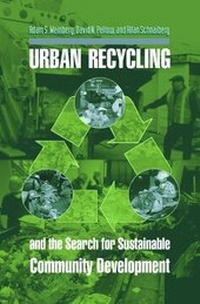
Urban Recycling and the Search for Sustainable Community Development
Published on 13. August 2000
Book
Hardback
232 pages
978-0-691-05014-0 (ISBN)
Description
More Americans recycle than vote. And most do so to improve their communities and the environment. But do recycling programs advance social, economic, and environmental goals? To answer this, three sociologists with expertise in urban and environmental planning have conducted the first major study of urban recycling. They compare four types of programs in the Chicago metropolitan area: a community-based drop-off center, a municipal curbside program, a recycling industrial park, and a linkage program. Their conclusion, admirably elaborated, is that recycling can realize sustainable community development, but that current programs achieve few benefits for the communities in which they are located. The authors discover that the history of recycling mirrors many other urban reforms. What began in the 1960s as a sustainable community enterprise has become a commodity-based, profit-driven industry. Large private firms, using public dollars, have chased out smaller nonprofit and family-owned efforts. Perhaps most troubling is that this process was not born of economic necessity. Rather, as the authors show, socially oriented programs are actually more viable than profit-focused systems.
This finding raises unsettling questions about the prospects for any sort of sustainable local development in the globalizing economy. Based on a decade of research, this is the first book to fully explore the range of impacts that recycling generates in our communities. It presents recycling as a tantalizing case study of the promises and pitfalls of community development. It also serves as a rich account of how the state and private interests linked to the global economy alter the terrain of local neighborhoods.
This finding raises unsettling questions about the prospects for any sort of sustainable local development in the globalizing economy. Based on a decade of research, this is the first book to fully explore the range of impacts that recycling generates in our communities. It presents recycling as a tantalizing case study of the promises and pitfalls of community development. It also serves as a rich account of how the state and private interests linked to the global economy alter the terrain of local neighborhoods.
Reviews / Votes
"[This] important book ostensibly concerns urban recycling, but it actually treats the paradox of sustainable community development in the age of global capitalism ... [It] has important implications for social, community, and environmental advocates, and for students of contemporary urban life."--Choice "Urban Recycling makes a refreshing change from the usual waste-management books with their worthy but often dull descriptions of the waste hierarchy and bottle banks... This text, an analysis of United States community recycling programmes, has a different approach, with emphasis on community rather than recycling."--Jane Powell, Times Higher Education Supplement "A sophisticated examination of recycling... Urban Recycling presents readers with a holisitic study that will illuminate the history of recycling while examining the problems of achieving sustainability within a profit-driven economic system."--Brett Clark, Organization and Development "The next time you finish that can of pop, you might want to just chuck the empty in the street. This is not the conclusion, but it is the implication, of Urban Recycling... [T]his book is a great read for anyone inside or outside academia wondering what to do with that empty pop can."--Randy Stoecker, Contemporary ScienceMore details
Language
English
Place of publication
New Jersey
United States
Target group
Professional and scholarly
College/higher education
Product notice
Trade binding
Illustrations
7 tables, 1 line illus.
Dimensions
Height: 229 mm
Width: 152 mm
Weight
510 gr
ISBN-13
978-0-691-05014-0 (9780691050140)
Copyright in bibliographic data and cover images is held by Nielsen Book Services Limited or by the publishers or by their respective licensors: all rights reserved.
Schweitzer Classification
Other editions
Additional editions
Adam S. Weinberg | David N. Pellow | Allan Schnaiberg
Urban Recycling and the Search for Sustainable Community Development
E-Book
07/2000
1st Edition
Princeton University Press
from
€227.95
Available for download
Persons
Adam S. Weinberg is Assistant Professor of Sociology at Colgate University and coauthor of Local Environmental Struggles. He has advised many communities, nonprofit organizations, and government agencies on sustainable development. David N. Pellow is Assistant Professor of Sociology and Ethnic Studies at the University of Colorado at Boulder. He has published widely on environmental racism and justice, participated in several federal initiatives, and served on the board of many nonprofit organizations. Allan Schnaiberg is Professor of Sociology at Northwestern University and a faculty associate of its Institute for Policy Research. His numerous publications include The Environment: From Surplus to Scarcity and Environment and Society: The Enduring Conflict.
Content
Acknowledgments ix Chapter One: Urban Recycling: An Empirical Test of Sustainable Community Development Proposals 3 Sustainable Community Development 4 Recycling as a Case Study in Sustainable Community Development 7 The Rise of Recycling: "Why Waste a Resource?" 9 Contemporary Recycling Practices 22 The Chicago Region as a locale for Examining Recycling and Sustainable Community Development 27 Chapter Two: The Challenge to Achieve Sustainable Community Development: A Theoretical Framework 30 The Treadmill of Production as a Modern Political-Economic Model 30 Conflict, Power, and Dialectics: A Political Economic Perspective 35 Allocating Scarcity: A Central Parameter 40 Political Consciousness in the Managed Scarcity Synthesis 43 The Treadmill of Production and Recycling: Overt and Covert Conflicts 43 Limitations of Our Analysis 47 Chapter Three: Chicago's Municipally Based Recycling Program: Origins and Outcomes of a Corporate-Centered Approach 50 Who Is Riding the Tiger? The Alliance between the City of Chicago and Waste Management, Incorporated 50 Promises and Pitfalls of the Blue Bag Program 54 Early Problems with the Blue Bag: Miscalculating Start-up Costs and Recovery Rates 58 Occupational Safety Issues: Challenges and Responses 66 Reclaiming the MRRFs: Chicago's Attempt to Regain Control 72 Conclusion: The Blue Bag Program and the Three Es of Sustainable Community Development 74 Chapter Four: Community-Based Recycling: The Struggles of a Social Movement 78 Community-Based Recycling Centers 78 The Model for Community-Based Recycling Centers: The Resource Center 78 Replicating the Resource Center: Uptown Recycling, Incorporated 83 Limitations of the Community-Based Model 90 Social Movement Struggles in a Global Marketplace: The Demise of Community-Based Recycling? 94 Moving toward the Three Es: Assessing the Achievements of the Community-Based Centers 100 Community-Based Sustainable Development Enterprises: "Doing Good but Not Doing Well" 104 Chapter Five: Industrial Recycling Zones and Parks: Creating Alternative Recycling Models 107 Environmental Movements and Industrial Ecology: The Logic of Recycling Parks and Recycling Zones 107 Promises in Maywood 110 Reviving West Garfield Park: The Bethel New Life Story 118 Resistance to Innovations: DuPage County and Gary, Indiana 120 Planning for Industrial Recycling Zones: Is Ecological Modernization in Our Future? 124 Chapter Six: Social Linkage Programs: Recycling Practices in Evanston 132 Finding Alternatives: The Road to Locating the Three Es 132 Recycling Working as a Social Linkage: The Rise of the PIC Program in Evanston 132 Delinking the Evanston Program: The New "Bottom Line" Orientation to Local Recycling 142 Understanding the Dimensions of Variability in Recycling Programs 149 Searching for Sustainable Development: Do Technology and Scale Matter? 151 Chapter Seven: The Treadmill of Production: Toward a Political-Economic Grounding of Sustainable Community Development 156 Revisiting the Treadmill of Production 156 The Globalizing Treadmill 158 The State's Ambivalent Role in Managing the Treadmill 162 Grounding Sustainable Community Development in the Treadmill of Production 164 Conclusion: Relationships in the Treadmill 172 Chapter Eight: The Search for Sustainable Community Development: Final Notes and Thoughts 176 The Political Economy of Solid Waste Management 176 Critical Social Science: Power, Education, Community, and Politics 179 The Economic Geography of Waste: Generalizing beyond Chicago and beyond Recycling 195 Final Reflections 199 References 203 Index 217