

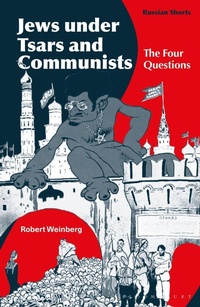
Jews under Tsars and Communists
The Four Questions
Published on 8. February 2024
Book
Hardback
160 pages
978-1-350-12916-0 (ISBN)
Description
Tracing the evolving nature of popular and official beliefs about the purported nature of the Jews from the 18th century onwards, Russia and the Jewish Question explores how perceptions of Jews in late Imperial Russia and the Soviet Union shaped the regimes' policies toward them. In so doing Robert Weinberg provides a fruitful lens through which to investigate the social, economic, political, and cultural developments of modern Russia.
Here, Weinberg reveals that the 'Jewish Question' - and, by extension anti-Semitism - emerged at the end of the 18th century when the partitions of Poland made hundreds of thousands of Jews subjects of the Russian crown. He skillfully argues the phrase itself implies the singular nature of Jews as a group of people whose religion, culture, and occupational make-up prevent them from fitting into predominantly Christian societies. The book then expounds how other characteristics were associated with the group over time: in particular, debates about rights of citizenship, the impact of industrialization, the emergence of the nation-state, and the proliferation of new political ideologies and movements contributed to the changing nature of the 'Jewish Question'. Its content may have not remained static, but its purpose consistently questions whether or not Jews pose a threat to the stability and well-being of the societies in which they live and this, in a specifically Russian context, is what Weinberg examines so expertly.
Here, Weinberg reveals that the 'Jewish Question' - and, by extension anti-Semitism - emerged at the end of the 18th century when the partitions of Poland made hundreds of thousands of Jews subjects of the Russian crown. He skillfully argues the phrase itself implies the singular nature of Jews as a group of people whose religion, culture, and occupational make-up prevent them from fitting into predominantly Christian societies. The book then expounds how other characteristics were associated with the group over time: in particular, debates about rights of citizenship, the impact of industrialization, the emergence of the nation-state, and the proliferation of new political ideologies and movements contributed to the changing nature of the 'Jewish Question'. Its content may have not remained static, but its purpose consistently questions whether or not Jews pose a threat to the stability and well-being of the societies in which they live and this, in a specifically Russian context, is what Weinberg examines so expertly.
Reviews / Votes
Robert Weinberg has produced an exceptional study of how Russian leaders viewed the Jewish question over the last two centuries ... This is an outstanding introduction to this topic. Highly recommended [for] general readers and undergraduates. * CHOICE *More details
Series
Language
English
Place of publication
London
United Kingdom
Publishing group
Bloomsbury Publishing PLC
Target group
College/higher education
Illustrations
20 bw illus
Dimensions
Height: 209 mm
Width: 132 mm
Thickness: 12 mm
Weight
270 gr
ISBN-13
978-1-350-12916-0 (9781350129160)
Copyright in bibliographic data and cover images is held by Nielsen Book Services Limited or by the publishers or by their respective licensors: all rights reserved.
Schweitzer Classification
Person
Robert Weinberg is Professor of History and International Relations at Swarthmore College, USA. He is the author of Ritual Murder in Late Imperial Russia: The Trial of Mendel Beilis (2013) and the co-author, along with Laurie Bernstein, of The Russian Revolution: A History in Documents(2010). He is also the co-editor, with Eugene Avrutin and Jonathan Dekel-Chen, of Worlds of Ritual Murder: Culture, Politics, and Belief in Eastern Europe and Beyond (2017).
Content
List of Illustations
1. Defining the Jewish Question in the Modern World
2. The Jewish Question in the Nineteenth Century
3. Pogroms, Politics, and Revolution
4. Communism and the Jewish Question
5. The Jewish Question in the Post-Soviet World
Index
1. Defining the Jewish Question in the Modern World
2. The Jewish Question in the Nineteenth Century
3. Pogroms, Politics, and Revolution
4. Communism and the Jewish Question
5. The Jewish Question in the Post-Soviet World
Index