

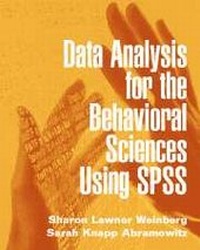
Data Analysis for the Behavioral Sciences Using SPSS
Published on 1. April 2002
Book
Hardback
752 pages
978-0-521-63208-9 (ISBN)
Description
This text is written from the perspective that statistics is an integrated set of tools used together to uncover the story contained in numerical data. Accordingly, the text comes with a disk containing a series of real data sets to motivate discussions of appropriate methods of analysis. The presentation is informal, yet rigorous; it is based on a conceptual approach supported by an understanding of underlying mathematical foundations. Students learn that more than one method of analysis is typically needed and that an ample characterization of results is a critical component of any data analytic plan. The use of real data and SPSS to perform computations and create graphical summaries not only enables a greater emphasis on conceptual understanding and interpretation, but also allows students to study statistics in a way that reflects statistical practice.
More details
Language
English
Place of publication
Cambridge
United Kingdom
Target group
Professional and scholarly
Illustrations
551 Tables, unspecified; 308 Line drawings, unspecified
Dimensions
Height: 262 mm
Width: 208 mm
Thickness: 46 mm
Weight
1664 gr
ISBN-13
978-0-521-63208-9 (9780521632089)
Copyright in bibliographic data and cover images is held by Nielsen Book Services Limited or by the publishers or by their respective licensors: all rights reserved.
Schweitzer Classification
Other editions
New editions
Book
03/2008
2nd Edition
Cambridge University Press
€106.64
Article exhausted; check for reprint
Persons
Content
1. Introduction; 2. Examining univariate distributions; 3. Measures of location, spread, and skewness; 4. Re-expressing variables; 5. Exploring relationships between two variables; 6. Simple linear regression; 7. Probability fundamentals; 8. Theoretical probability models; 9. The role of sampling in inferential statistics; 10. Inferences involving the mean of a single population when o is known; 11. Inferences involving the mean when o is not known: one and two sample designs; 12. One-way analysis of variance; 13. Two-way analysis of variance; 14. Correlation and simple regression as inferential techniques; 15. An introduction to multiple regression; 16. Nonparametric methods; Appendix A. Data set descriptions; Appendix B. SPSS macro to generate a sampling distrubution of means; Appendix C. Statistical tables; Appendix D. References; Appendix E. Solutions to exercises.