

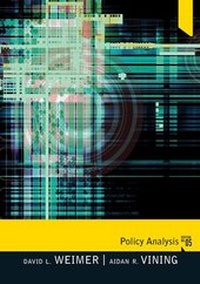
Policy Analysis
Concepts and Practice
5th Edition
Published on 18. February 2010
Book
Paperback/Softback
496 pages
978-0-205-78130-0 (ISBN)
Description
Updated in a new 5th edition, this book lays a strong conceptual foundation to understanding the rationales of and limitations to public policy. It gives practical advice about how to do policy analysis while demonstrating the application of advanced analytical techniques through case study examples
Policy Analysis: Concepts and Practices is a comprehensive, accessible, and rich introduction to policy analysis for readers in public policy, public administration, and business programs.
Policy Analysis: Concepts and Practices is a comprehensive, accessible, and rich introduction to policy analysis for readers in public policy, public administration, and business programs.
More details
Other editions
New editions
Book
03/2017
6th Edition
Routledge
€170.84
Article exhausted; check for reprint
Previous edition
Book
07/2004
4th Edition
Routledge
Unfortunately, price unknown
No shipping information available
Persons
David Weimer is a Professor at University of Wisconsin-Madison, USA.
Aidan R. Vining is a Professor at Simon Fraser University, Canada.
Aidan R. Vining is a Professor at Simon Fraser University, Canada.
Content
Preface
Acknowledgments
List of Figures
List of Tables
PART I: Introduction to Public Policy Analysis
1. What is Policy Analysis?
PART II: Conceptual Foundations for Problem Analysis
4. Efficiency and the Idealized Competitive Model
5. Rationales for Public Policy: Market Failures
6. Rationales for Public Policy: Other Limitations of the Competitive Framework
7. Rationales for Public Policy: Distributional and Other Goals
8. Limits to Public Intervention: Government Failures
9. Policy Problems as Market and Government Failure
PART III: Conceptual Foundations for Solution Analysis
10. Correcting Market and Government Failures: Generic Policy Instruments
11. Adoption
12. Landing on Your Feet: Organizing Your Policy Analysis
13. Implementation
PART IV: Doing Policy Analysis
14. Government Supply: Drawing Organizational Boundaries
15. Gathering Information for Policy Analysis
16: Goals/Alternatives Matrices: Some Examples from CBO Studies
17: Benefit-Cost Analysis
18: When Statistics Count: Revising the Lead Standard for Gasoline
Acknowledgments
List of Figures
List of Tables
PART I: Introduction to Public Policy Analysis
1. What is Policy Analysis?
PART II: Conceptual Foundations for Problem Analysis
4. Efficiency and the Idealized Competitive Model
5. Rationales for Public Policy: Market Failures
6. Rationales for Public Policy: Other Limitations of the Competitive Framework
7. Rationales for Public Policy: Distributional and Other Goals
8. Limits to Public Intervention: Government Failures
9. Policy Problems as Market and Government Failure
PART III: Conceptual Foundations for Solution Analysis
10. Correcting Market and Government Failures: Generic Policy Instruments
11. Adoption
12. Landing on Your Feet: Organizing Your Policy Analysis
13. Implementation
PART IV: Doing Policy Analysis
14. Government Supply: Drawing Organizational Boundaries
15. Gathering Information for Policy Analysis
16: Goals/Alternatives Matrices: Some Examples from CBO Studies
17: Benefit-Cost Analysis
18: When Statistics Count: Revising the Lead Standard for Gasoline