

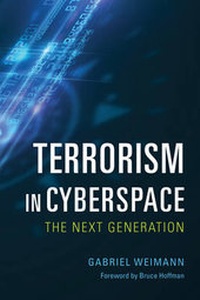
Terrorism in Cyberspace
The Next Generation
Published on 21. April 2015
Book
Paperback/Softback
344 pages
978-0-231-70449-6 (ISBN)
Description
The war on terrorism has not been won, Gabriel Weimann argues in Terrorism in Cyberspace, the successor to his seminal Terror on the Internet. Even though al-Qaeda's leadership has been largely destroyed and its organization disrupted, terrorist attacks take 12,000 lives annually worldwide, and jihadist terrorist ideology continues to spread. How? Largely by going online and adopting a new method of organization. Terrorist structures, traditionally consisting of loose-net cells, divisions, and subgroups, are ideally suited for flourishing on the Internet through websites, e-mail, chat rooms, e-groups, forums, virtual message boards, YouTube, Google Earth, and other outlets. Terrorist websites, including social media platforms, now number close to 10,000. This book addresses three major questions: why and how terrorism went online; what recent trends can be discerned-such as engaging children and women, promoting lone wolf attacks, and using social media; and what future threats can be expected, along with how they can be reduced or countered.
To answer these questions, Terrorism in Cyberspace analyzes content from more than 9,800 terrorist websites, and Weimann, who has been studying terrorism online since 1998, selects the most important kinds of web activity, describes their background and history, and surveys their content in terms of kind and intensity, the groups and prominent individuals involved, and effects. He highlights cyberterrorism against financial, governmental, and engineering infrastructure; efforts to monitor, manipulate, and disrupt terrorists' online efforts; and threats to civil liberties posed by ill-directed efforts to suppress terrorists' online activities as future, worrisome trends.
To answer these questions, Terrorism in Cyberspace analyzes content from more than 9,800 terrorist websites, and Weimann, who has been studying terrorism online since 1998, selects the most important kinds of web activity, describes their background and history, and surveys their content in terms of kind and intensity, the groups and prominent individuals involved, and effects. He highlights cyberterrorism against financial, governmental, and engineering infrastructure; efforts to monitor, manipulate, and disrupt terrorists' online efforts; and threats to civil liberties posed by ill-directed efforts to suppress terrorists' online activities as future, worrisome trends.
Reviews / Votes
Terrorism in Cyberspace represents the next step in its author's decades-long quest to map, analyze, and understand the evolution of terrorist communications since the advent of the Internet and this new form of mass communication. -- From the foreword by Bruce Hoffman Its sweeping expertise and insight will make this book one of the most important and eagerly anticipated studies to be published on this subject. It will also be considered an 'instant classic' in the field. -- Joshua Sinai, Resilient Corporation, Alexandria, Virginia Terrorism in Cyberspace is a timely and indispensable resource for all those concerned about effectively countering terrorists' exploitation of the Internet's and the dark elements that can reside there. -- Joshua Sinai The Washington Times Weimann's book is engaging and concise, analyzing terrorist communications and critiquing government responses without sensationalism. Yale Global A timely and indispensable resource for all those concerned about effectively countering terrorists' exploitation of the Internet's and the dark elements that can reside there. Perspectives on Terrorism Weimann methodically zeroes in on the many ways that terrorists exploit cyberspace. -- Lawrence D. Freedman Foreign Affairs An excellent analysis of jihadists' online content and is a very good contribution to the literature on terrorism in cyberspace. -- David R. Mair H-Diplo Highly recommended. Dailey News, Bowling Green Timely and valuable for a wide audience of readers... Despite the essential difficulty and complexity of material, the author establishes a clear structure and masterfully guides readers through a diverse set of topics. Modern Diplomacy No better description of terrorists' online actions currently exists, and any scholar or policymaker who hopes to understand what terrorists are doing online should start with this book... simultaneously academic and appropriately structured. Political Science Quarterly An exceptional book that covers a broad spectrum of issues and challenges pertaining to terrorism in cyberspace. Insight TurkeyMore details
Language
English
Place of publication
New York
United States
Product notice
Paperback (trade)
Illustrations
6 b&w illustrations
Dimensions
Height: 229 mm
Width: 152 mm
Weight
510 gr
ISBN-13
978-0-231-70449-6 (9780231704496)
Copyright in bibliographic data and cover images is held by Nielsen Book Services Limited or by the publishers or by their respective licensors: all rights reserved.
Schweitzer Classification
Other editions
Additional editions
Book
04/2015
Columbia University Press
€86.80
Article exhausted; check different version
Persons
Gabriel Weimann is professor of communication at the University of Haifa, Israel. He was a Fellow at the Wilson Center from 2013 to 2014.
Content
Figures Foreword, by Bruce Hoffman Acknowledgments Introduction Part I. Terrorism Enters Cyberspace 1. Terrorism Enters Cyberspace Part II. Emerging Trends 2. Narrowcasting 3. Lone Wolves in Cyberspace 4. The E-Marketing of Terror 5. Debates Online 6. Online Fatwas 7. Terror on Social Media Part III. Future Threats and Challenges 8. Cyberterrorism 9. Countermeasures: "Noise" and the M.U.D. Model 10. The War of Narratives 11. Challenging Civil Liberties References Index