

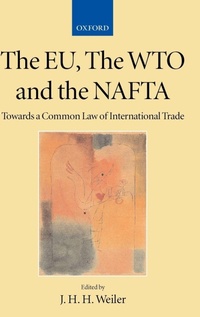
The EU, the WTO and the NAFTA
Towards a Common Law of International Trade
Published on 10. August 2000
Book
Hardback
258 pages
978-0-19-829874-8 (ISBN)
Description
The starting point of this book is the coexistence of the overlapping regimes of the WTO, the EU and the NAFTA. On this basis it explores the emergence of a nascent Common Law of International Trade.
This exploration is rooted in three phenomena:
Firstly, the fact that the very same regulatory measure may come simultaneously within the jurisdictional reach of more than one trade regime and may even be adjudicated simultaneously. Some regimes offer alternatives. The NAFTA, for example, offers GATT dispute resolution as an option for many of its own disputes.
Secondly, convergence in the material law of the disparate international trade regimes. This, of course, is the heart of the emergent Common Law.
Thirdly, the strengthening of private parties in all regimes. Once a preserve of the EU, the NAFTA allows private party dispute resolution of different types in relation to various matters and in the case of the WTO, although it is still an intergovernmental preserve, private actors are learning to manipulate the system.
This volume, built on a recent series of courses at the Academy of European Law, is a reflection of this conviction. The various contributions deal with discrete areas in the double sense of the international trading system but each placing considerable emphasis on the interlocking nature of the various components of that system. It is our conviction that this is the appropriate way to understand and to teach this branch of the law.
This exploration is rooted in three phenomena:
Firstly, the fact that the very same regulatory measure may come simultaneously within the jurisdictional reach of more than one trade regime and may even be adjudicated simultaneously. Some regimes offer alternatives. The NAFTA, for example, offers GATT dispute resolution as an option for many of its own disputes.
Secondly, convergence in the material law of the disparate international trade regimes. This, of course, is the heart of the emergent Common Law.
Thirdly, the strengthening of private parties in all regimes. Once a preserve of the EU, the NAFTA allows private party dispute resolution of different types in relation to various matters and in the case of the WTO, although it is still an intergovernmental preserve, private actors are learning to manipulate the system.
This volume, built on a recent series of courses at the Academy of European Law, is a reflection of this conviction. The various contributions deal with discrete areas in the double sense of the international trading system but each placing considerable emphasis on the interlocking nature of the various components of that system. It is our conviction that this is the appropriate way to understand and to teach this branch of the law.
Reviews / Votes
Although easily readable, the audience for this volume is primarily lawyers or persons trained in the law. ... Together ... the essays constitute a coherent introduction to the evolution, major institutions, issues and developments in international trade law. ...Robert Howse's essay on 'Adjudicative Legitimacy and Treaty Interpretation in International Trade' .. provides a good critique of the major legitimacy and overnance issues associated with the regulatory instruments of international trade as well as a good theoretical framework for understanding them. * Interights Bulletin Vol. 13, No. 4, 2001 * this is an excellent, thought-provoking collection of essays which can be read with profit by both European and international lawyers. There has been much discussion coparing the institutional stuctures of the EU and the WTO, in particular about whether one can speak of the "constitution" of the WTO. This volume concentrates rather on the substantive law of the two organisations. This departure is to be welcomed. * Matthew Happold International and Comparative Law Quarterly *More details
Series
Language
English
Place of publication
Oxford
United Kingdom
Target group
Professional and scholarly
Dimensions
Height: 240 mm
Width: 161 mm
Thickness: 19 mm
Weight
558 gr
ISBN-13
978-0-19-829874-8 (9780198298748)
Copyright in bibliographic data and cover images is held by Nielsen Book Services Limited or by the publishers or by their respective licensors: all rights reserved.
Schweitzer Classification
Other editions
Additional editions
Book
04/2001
Oxford University Press
€64.10
Shipment within 15-20 days
Person
J.H.H. Weiler is Manley Hudson Professor of Law and Jean Monnet Chair at Harvard University.
He is a faculty member at the College of Europe in Bruges, Belgium and an Honorary Professor at University College, London University and at the University of Copenhagen. He is Director of the Academy-on-Line of the Academy of European Law, EUI, Florence.
He is Fellow of the American Academy of Arts and Sciences.
He is a faculty member at the College of Europe in Bruges, Belgium and an Honorary Professor at University College, London University and at the University of Copenhagen. He is Director of the Academy-on-Line of the Academy of European Law, EUI, Florence.
He is Fellow of the American Academy of Arts and Sciences.
Content
Introduction: Cain and Abel - Convergence and Divergence in International Trade Law ; 1. EC External Commercial Policy after Amsterdam: Authority and Interpretation within Interconnected Legal Orders ; 2. Adjudicative Legitimacy and Treaty Interpretation in International Trade Law: The Early Years of WTO Jurisprudence ; 3. The European Court of Justice and the WTO: Problems and Challenges ; 4. On Kith and Kine (and Crustaceans): Trade and Environment in the EU and WTO ; 5. The North American Integration Regime and its Implications for the World Trading System ; Epilogue: Towards a Common Law