

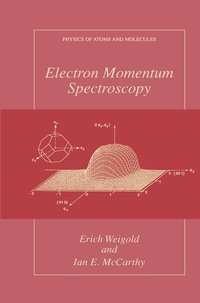
Electron Momentum Spectroscopy
Published on 31. December 1999
Book
Hardback
X, 273 pages
978-0-306-46157-6 (ISBN)
Description
Electron Momentum Spectroscopy
measures the energy-momentum density of the electrons in atoms, molecules and solids by means of a kinematically-complete ionization reaction initiated by an electron beam. The construction of spectrometers and the acquisition and reduction of cross-section data are described in detail. The quantum theory of the reaction is explained and the experimental verification is given. It is shown how to extract quasiparticle orbitals, and coefficients describing electron correlations of the data. These quantities are derived from the many-body theory of the electronic structure of atoms, molecules and solids. The relationship to less complete methods of investigating electronic structure is discussed.
Examples are given of the determination of atomic and molecular orbitals and quantities relating them to the observed states of the residual ion. For amorphous, polycrystalline and crystalline solids and surfaces, examples show the energy-momentum density of valence electron bands, and effects due to electron diffraction and plasmon excitation.
The book aims to give a complete account of electron momentum spectroscopy to date. Its significance is that it is a sensitive and experimentally-verifiable test of essentially every aspect of calculations of electronic structure. It is the only such probe available.
Examples are given of the determination of atomic and molecular orbitals and quantities relating them to the observed states of the residual ion. For amorphous, polycrystalline and crystalline solids and surfaces, examples show the energy-momentum density of valence electron bands, and effects due to electron diffraction and plasmon excitation.
The book aims to give a complete account of electron momentum spectroscopy to date. Its significance is that it is a sensitive and experimentally-verifiable test of essentially every aspect of calculations of electronic structure. It is the only such probe available.
More details
Series
Edition
1999
Language
English
Place of publication
New York
United States
Publishing group
Springer Science+Business Media
Target group
Professional and scholarly
Research
Illustrations
X, 273 p.
Dimensions
Height: 241 mm
Width: 160 mm
Thickness: 22 mm
Weight
598 gr
ISBN-13
978-0-306-46157-6 (9780306461576)
DOI
10.1007/978-1-4615-4779-2
Schweitzer Classification
Other editions
Additional editions
Erich Weigold | Ian McCarthy
Electron Momentum Spectroscopy
E-Book
12/2012
Springer
€213.99
Available for download
Erich Weigold | Ian McCarthy
Electron Momentum Spectroscopy
Book
09/2012
Springer
€213.99
Shipment within 7-9 days
Content
1. Introduction to Electron Momentum Spectroscopy.- 1.1. Electron Impact Ionization.- 1.2. Units.- 1.3. EMS Kinematics.- 1.4. The Relation between Coordinate and Momentum Space: The Hydrogen Atom and the Free Particle.- 1.5. The Ionization Cross Section.- 1.6. Semiclassical Picture of EMS.- 1.7. Quantum-Mechanical Description of EMS.- 2. Experimental Techniques.- 2.1. Electron Sources.- 2.2. Detection of Electrons.- 2.3. Electron Momentum Analyzers.- 2.4. Target Preparation.- 2.5. Coincidence Techniques.- 2.6. Multiparameter Data Acquisition and Reduction.- 3. Theory of Electron Momentum Spectroscopy.- 3.1. The Born-Oppenheimer Approximation.- 3.2. The Binary-Encounter Approximation.- 3.3. The Impulse Approximation.- 3.4. The Distorted-Wave Impulse Approximation.- 3.5. The Structure Amplitude.- 4. Outline of Structure Theory.- 4.1. Symmetry of a Molecular Orbital.- 4.2. The Hartree-Fock Method.- 4.3. Self-Consistent-Field Orbitals.- 4.4. Density-Functional Theory.- 4.5. Electron Band Theory of a Crystal.- 4.6. The Quasiparticle Equation.- 4.7. The Weak-Coupling Approximation.- 5. Atoms.- 5.1. Orbital Mapping.- 5.2. Relativistic Effects.- 5.3. Excited and Oriented Target States.- 5.4. Initial- and Final-State Correlations.- 6. Molecules.- 6.1. Momentum-Space Chemistry.- 6.2. Molecular Examples.- 6.3. Outer Valence Region.- 6.4. Inner Valence Region.- 6.5. Core States.- 6.6. Summary.- 7. Solids.- 7.1. The Flinders Experiments.- 7.2. Polycrystalline Aluminum.- 7.3. Aluminum Oxide.- 7.4. Crystalline Graphite.- 7.5. Silicon.- 7.6. Allotropes of Carbon.- 7.7. Copper.- 8. Comparison with Other Spectroscopies.- 8.1. Summary of EMS.- 8.2. Partially-Integrated Momentum Densities.- 8.3. Photoelectron Spectroscopy.- References.