

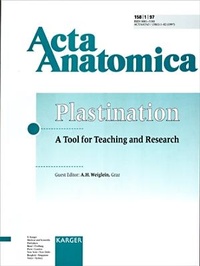
Plastination
A Tool for Teaching and Research. The 8th International Conference on Plastination, Brisbane, July 1996. "Acta Anatomica", Vol 158, No 1. Special Topic Issue: Cells Tissues Organs 1997, Vol. 158, No. 1
Published on 13. August 1997
Book
Paperback/Softback
82 pages
978-3-8055-6572-1 (ISBN)
Description
Plastination is a unique technique of tissue preservation developed by G. von Hagens in 1978. In this process, water and lipids in biological tissues are replaced by polymers such as silicone, epoxy or polyester, which are subsequently hardened, resulting in dry, odorless and durable specimens. The class of polymer used determines the optical and mechanical properties of the impregnated specimen. Silicone rubber is used for plastination of whole specimens and thick body and organ slices; epoxy resins are used for hard, thin, transparent body and organ slices; and polyester-copolymer is exclusively used for hard brain slices to gain an excellent distinction of gray and white matter. The techniques of sheet plastination using epoxy or polyester have become very important in human and veterinary anatomy, histology and pathology. Plastinated material is frequently used in correlation with MRI and CT scans, in teaching neuroanatomy and in plastination histology. Plastination also allows the freezing of movable and flexible tissues in a particular stage, e.g. for investigating the vascularity of the lunate bone. Since the methods of plastination are still being developed, several technical articles dealing mainly with safety problems have been included in this issue. Offering the most up-to-date information on this promising technique, this special issue will be appreciated by human and veterinary anatomists, histologists, pathologists, radiologists as well as by clinicians like ENT and orthopedic surgeons with an interest in basic research.
More details
Language
English
Place of publication
Basel
Switzerland
Target group
College/higher education
Professional and scholarly
Illustrations
61 Abbildungen, 5 Tabellen
61 figs., 9 in color, 5 tab.
Dimensions
Height: 28 cm
Width: 21 cm
Weight
320 gr
ISBN-13
978-3-8055-6572-1 (9783805565721)
Schweitzer Classification
Content
Plastination in the neurosciences - keynote lecture, A.H. Weiglein; setting up and features of a database of images of plastinated materials, Y. Masuda et al; the potentially best stereographic presentation of the plastinated anatomical specimen, M. Taguchi et al; reclamation of acetone in plastination laboratories - a simple and inexpensive method, G. Grondin et al; design of lifting gear for a plastination laboratory, P. Bore et al; sheet plastination as a clinically based teaching aid at the University of Auckland, P. Cook; learning relational anatomy by correlating thin plastinated sections and magnetic resonance images - preparation of specimens, M. Magiros et al; correlating sheet plastinated slices, computer tomography images and magnetic resonance images of the pelvic girdle - a teaching tool, C.A.C. Entius et al; plastinated canine gastrointestinal tracts used to facilitate teaching of endoscopic technique and anatomy, L. Janick et al; E12 technique - an aid to study sinuses of psittacine birds, R.W. Henry et al; distribution of muscle spindles in the extensor digitorum and hallucis brevis muscle of the macaque as determined by plastination, A. Matsumura and K. Saito; sheet plastination of the vascularity of the lunate bone - a morphological study, M. Schiltenwolf et al; sheet plastination of the larynx for whole-organ histology, C. Sittel et al.