

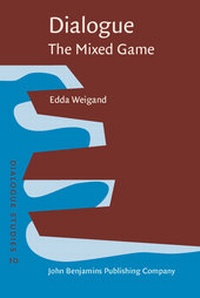
Dialogue - The Mixed Game
Published on 22. December 2010
Book
Hardback
304 pages
978-90-272-1027-2 (ISBN)
Description
The 'Mixed Game Model' represents a holistic theory of dialogue which starts from human beings' competence-in-performance and describes how language is integrated in a general theory of human action and behaviour. Human beings are able to adapt to changing conditions and to pursue their interests by the integrated use of various communicative means, mainly verbal, perceptual and cognitive. The core unit is the dialogic action game or 'the mixed game' with human beings at the centre acting and reacting in cultural surroundings. The key to opening up the complex whole is human beings' nature. The Mixed Game Model demonstrates how the different disciplines of the natural and social sciences and the humanities are mutually interconnected. After a detailed overview of the state of the art, the fundamentals of the theory are laid down. They include a typology of action games which ranges from minimal games to complex institutional games. The description is illustrated by analyses of authentic games.
As of July 2024, this e-book is available as Open Access under the CC BY-NC-ND license.
As of July 2024, this e-book is available as Open Access under the CC BY-NC-ND license.
More details
Series
Language
English
Place of publication
Amsterdam
Netherlands
Target group
Professional and scholarly
Illustrations
+ index
Dimensions
Height: 245 mm
Width: 164 mm
Weight
730 gr
ISBN-13
978-90-272-1027-2 (9789027210272)
Copyright in bibliographic data and cover images is held by Nielsen Book Services Limited or by the publishers or by their respective licensors: all rights reserved.
Schweitzer Classification
Other editions
Additional editions
Edda Weigand
Dialogue - The Mixed Game
E-Book
12/2010
John Benjamins Publishing Company
€118.99
Available for download
Person
Content
1. Preface; 2. Introduction: The simple and the complex; 3. I. Rethinking theory: Patterns & beyond; 4. 1. The state of the art; 5. 2. The turning point in theorizing: Starting from the integrated whole; 6. II. The Theory of Dialogic Action Games or the Mixed Game Model; 7. 1. Premises about the object: From human affairs to language; 8. 2. The methodology: Principles of Probability; 9. 3. To sum up: The mixed game of human competence-in-performance; 10. III. Minimal action games or the issue of a speech act taxonomy; 11. 1. Minimal versus complex action games; 12. 2. Controversial issues in setting up a taxonomy of speech acts: The state of the art; 13. 3. The issue of a dialogic taxonomy of speech acts; 14. 4. To sum up; 15. IV. The architecture of complex action games; 16. 1. Extending the minimal game; 17. 2. Complex human affairs: Dialogue in the stream of life; 18. 3. Literary action games or touching on the mystery of life; 19. 4. To sum up: Dialogue in human affairs; 20. Summary and outlook: Towards an understanding of the dialogic species; 21. References; 22. Appendix; 23. Index