

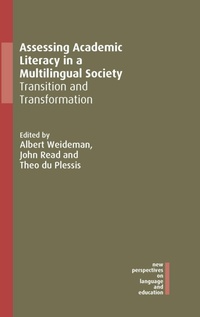
Assessing Academic Literacy in a Multilingual Society
Transition and Transformation
Published on 2. November 2020
Book
Hardback
280 pages
978-1-78892-620-1 (ISBN)
Description
South African universities face major challenges in meeting the needs of their students in the area of academic language and literacy. The dominant medium of instruction in the universities is English and, to a much lesser extent, Afrikaans, but only a minority of the national population are native speakers of these languages. Nine other languages can be media of instruction in schools, which makes the transition to tertiary education difficult enough in itself for students from these schools. The focus of this book is on procedures for assessing the academic language and literacy levels and needs of students, not in order to exclude students from higher education but rather to identify those who would benefit from further development of their ability in order to undertake their degree studies successfully. The volume also aims to bring the innovative solutions designed by South African educators to a wider international audience.
Reviews / Votes
What is academic literacy and how can it best be measured? The authors of this excellent edited collection draw on 20+ years of research and practice to highlight the challenges involved in assessing the language and literacy needs of students destined for university education in multilingual South Africa. Their insights will resonate with academics and educators around the world catering for increasingly diverse student populations. * Catherine Elder, University of Melbourne, Australia * This invaluable collection of engaging chapters is a must-read for practitioners, graduate students, and researchers who seek to expand their knowledge of assessment literacy in multilingual societies in and beyond South Africa. The editors' choice of conceptual foundations of academic literacy assessment at pre-tertiary and tertiary education as the themes of the volume is timely and insightful. * Vahid Aryadoust, National Institute of Education, Nanyang Technological University, Singapore * Language ability, language assessment to determine ability levels, and improving academic literacy in a multilingual tertiary context are complex issues. This book establishes what all these actually comprise. The quality of the work and the standing of the contributors combine to give us an informed view of this exciting and developing field in South Africa. Read and enjoy! * Wannie Carstens, North-West University, South Africa * [This book] is an excellent collection of contemporary research studies into the assessment of academic language literacy in South Africa [...] Its extensive and thought-provoking coverage of the issues faced by education systems, institutions and individuals within them will serve as a valuable resource as they plan the road ahead in this rapidly changing field. -- Alan Urmston, Hong Kong Polytechnic University, Hong Kong * Journal of English for Academic Purposes, 2021 *More details
Series
Language
English
Place of publication
Bristol
United Kingdom
Target group
College/higher education
Dimensions
Height: 240 mm
Width: 161 mm
Thickness: 19 mm
Weight
578 gr
ISBN-13
978-1-78892-620-1 (9781788926201)
DOI
10.21832/WEIDEM6201
Copyright in bibliographic data and cover images is held by Nielsen Book Services Limited or by the publishers or by their respective licensors: all rights reserved.
Schweitzer Classification
Other editions
Additional editions
Albert Weideman | John Read | Theo Du Plessis
Assessing Academic Literacy in a Multilingual Society
Transition and Transformation
E-Book
11/2020
Multilingual Matters
€24.49
Available for download
Complete work / Part of the work
Phan Le Ha | Joel Austin Windle
New Perspectives on Language and Education (Vols 81-90)
Book
Multilingual Matters
€1,032.48
The article will not be published
Persons
Albert Weideman is Professor of Applied Language Studies and Research Fellow at the University of the Free State, South Africa.
John Read is Professor Emeritus at the University of Auckland, New Zealand.
Theo du Plessis is Professor of Language Management at the University of the Free State, South Africa.
John Read is Professor Emeritus at the University of Auckland, New Zealand.
Theo du Plessis is Professor of Language Management at the University of the Free State, South Africa.
Content
Introduction. John Read and Colleen Du Plessis: A Global Perspective on the South African Context
Part I: Conceptual Foundations: Policy, Construct, Learning Potential
Chapter 1. Theo du Plessis: Institutional Language Policy and Academic Literacy in South African Higher Education
Chapter 2. Albert Weideman: A Skills-neutral Approach to Academic Literacy Assessment
Chapter 3. Tobie van Dyk, Piet Murre and Herculene Kotze: Does One Size Fit All? Some Considerations for Test Translation
Chapter 4. Alan Cliff: The Use of Mediation and Feedback in a Standardised Test of Academic Literacy: Theoretical and Design Considerations
Part II: Assessing Academic Literacy at Secondary School Level
Chapter 5. Colleen du Plessis: Basic Education and Academic Literacy: Conflicting Constructs in the South African National Senior Certificate (NSC) Language Examination
Chapter 6. Jo-Mari Myburgh-Smit and Albert Weideman: How Early Should We Measure Academic Literacy? The Usefulness of an Appropriate Test of Academic Literacy for Grade 10 Students
Chapter 7. Sanet Steyn: Pathways to Parity between Parallel Tests of Language Ability: Lessons from a Project
Part III: Assessing Discipline-specific Needs at University
Chapter 8. Kabelo Sebolai: Generic Academic Literacy Testing: A Logical Precursor for Faculty-specific Language Teaching and Assessment
Chapter 9. Avasha Rambiritch, Linda Alston and Marien Graham: Diagnosing with Care: The Academic Literacy Needs of Theology Students
Chapter 10. Laura Drennan: Assessing Readiness to Write: the Design of an Assessment of Preparedness to Present Multimodal Information (APPMI)
Postscript. Tobie van Dyk: What the Data Tell us: An Overview of Language Assessment Research in South Africa's Multilingual Context
Part I: Conceptual Foundations: Policy, Construct, Learning Potential
Chapter 1. Theo du Plessis: Institutional Language Policy and Academic Literacy in South African Higher Education
Chapter 2. Albert Weideman: A Skills-neutral Approach to Academic Literacy Assessment
Chapter 3. Tobie van Dyk, Piet Murre and Herculene Kotze: Does One Size Fit All? Some Considerations for Test Translation
Chapter 4. Alan Cliff: The Use of Mediation and Feedback in a Standardised Test of Academic Literacy: Theoretical and Design Considerations
Part II: Assessing Academic Literacy at Secondary School Level
Chapter 5. Colleen du Plessis: Basic Education and Academic Literacy: Conflicting Constructs in the South African National Senior Certificate (NSC) Language Examination
Chapter 6. Jo-Mari Myburgh-Smit and Albert Weideman: How Early Should We Measure Academic Literacy? The Usefulness of an Appropriate Test of Academic Literacy for Grade 10 Students
Chapter 7. Sanet Steyn: Pathways to Parity between Parallel Tests of Language Ability: Lessons from a Project
Part III: Assessing Discipline-specific Needs at University
Chapter 8. Kabelo Sebolai: Generic Academic Literacy Testing: A Logical Precursor for Faculty-specific Language Teaching and Assessment
Chapter 9. Avasha Rambiritch, Linda Alston and Marien Graham: Diagnosing with Care: The Academic Literacy Needs of Theology Students
Chapter 10. Laura Drennan: Assessing Readiness to Write: the Design of an Assessment of Preparedness to Present Multimodal Information (APPMI)
Postscript. Tobie van Dyk: What the Data Tell us: An Overview of Language Assessment Research in South Africa's Multilingual Context