

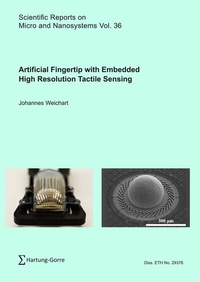
Artificial Fingertip with Embedded High Resolution Tactile Sensing
1st Edition
Published on 29. November 2023
Book
Paperback/Softback
XX, 158 pages
978-3-86628-802-7 (ISBN)
Description
The replication of the human sense of touch in robots or prostheses would greatly enhance their ability to interact with the environment. This thesis investigates the possibility to rebuild a human fingertip with its mechanical sensing capabilities. A soft, human-sized artificial fingertip was developed, equipped with an array of 144 tactile sensors (taxels). These 0.5 mm diameter taxels can detect touch, vibrations, and shear, enabling the artificial finger to distinguish between different external stimuli.
This thesis describes the design of the taxels, the fabrication as well as the characterization. The taxels can sense pressures with a sensitivity of 2.6 kPa-1 and were tested in a temperature range of 20 - 80° C as well as over 10'000 cycles. The sensing characteristics are determined by the thickness of a spray-coated silicone layer that encases the sensors, increasing their robustness to external influences. The static and dynamic sensing capabilities of the encapsulated taxels were evaluated. The sensitivity can be modifed according to the needs of an application. Skin thicknesses between 0 - 660µm allowed sensitivities of 0.86 - 0.035 kPa-1. A similar trend was observed for dynamic sensing capabilities.
The softness of a human finger was measured to create an artificial finger of similar conformity. Simulation results supported the transfer of taxel characteristics from on-chip to the soft fingertip. Miniaturized readout electronics allowed to read the full finger at 220 Hz, enabling the observation of touch and slipping events on the artificial finger and the estimation of the contact force. Slipping events can be detected as vibrations registered by individual sensors, while the contact force can be estimated by averaging sensor array readouts. The robustness of the fingers was tested by applying 15 N for >2000 times, which resulted in only minor degradation in stiffened membranes. Neural networks were tested to extract simple features like object recognition or the evaluation of contact force and location. Good classification scores of ~90% could be achieved on an early version of the artificial finger.
More details
Persons
Johannes Weichart was born in Hamburg, Germany, he is citizen of Liechtenstein.
Education
03/2019 _ 05/2023 Micro and Nanosystems, ETH Zurich, Switzerland
PhD Dissertation "Arti_cial Fingertip with Embedded
High Resolution Tactile Sensing"
09/2013 _ 09/2015 MSc Mechanical Engineering, ETH Zurich,
Switzerland
Focus: Mechatronics & Production technology
09/2014 _ 12/2014 Exchange Semester, University of Toronto, Canada
09/2009 _ 06/2012 BSc Mechanical Engineering, ETH Zurich, Switzerland
Focus: Focus Project "Skye" and robotics