

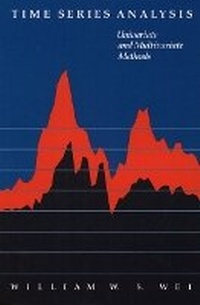
Time Series Analysis
Univariate and Multivariate Methods
Published on 1. January 1989
Book
Paperback/Softback
496 pages
978-0-201-15911-0 (ISBN)
Description
Emphasizing and providing a broad coverage of methodology, this comprehensive book is of interest to a variety of people in the applied sciences who want to know how time series can be used in their areas of research. The book provides useful examples that show the operational details and purpose of the methods. It covers methods extensively, and illustrates them with numerous figures, tables and examples using many real-life time series data sets. The book also introduces univariate and multivariate time series models and methods which are useful for analyzing, modeling, and forecasting data collected sequentially in time, and provides a balanced treatment between theory and applications.
Time Series Analysis is a thorough introduction to both time-domain and frequency-domain analyses, and it gives extensive coverage of both univariate and multivariate time series methods, including the most recently developed techniques in the field.
Time Series Analysis is a thorough introduction to both time-domain and frequency-domain analyses, and it gives extensive coverage of both univariate and multivariate time series methods, including the most recently developed techniques in the field.
More details
Language
English
Place of publication
United States
Publishing group
Pearson Education (US)
Target group
Professional and scholarly
Dimensions
Height: 170 mm
Width: 243 mm
Thickness: 30 mm
Weight
1398 gr
ISBN-13
978-0-201-15911-0 (9780201159110)
Copyright in bibliographic data and cover images is held by Nielsen Book Services Limited or by the publishers or by their respective licensors: all rights reserved.
Schweitzer Classification
Other editions
New editions
Book
09/2005
2nd Edition
Pearson
€108.93
Article exhausted; check for reprint
Content
1. Overview.
2. Fundamental Concepts.
3. Stationary Time Series Models.
4. Non-Stationary Time Series Models.
5. Forecasting.
6. Model Identification.
7. Parameter Estimation, Diagnostic Checking, and Model Selection.
8. Seasonal Time Series Models.
9. Intervention Analysis and Outlier Detection.
10. Fourier Analysis.
11. Spectral Theory of Stationary Processes.
12. Estimation of the Spectrum.
13. Transfer Function Models.
14. Vector Time Series Models.
15. State Space Models and the Kalman Filter.
16. Aggregation and Systematic Sampling in Time Series.
17. References.
18. Appendix.
2. Fundamental Concepts.
3. Stationary Time Series Models.
4. Non-Stationary Time Series Models.
5. Forecasting.
6. Model Identification.
7. Parameter Estimation, Diagnostic Checking, and Model Selection.
8. Seasonal Time Series Models.
9. Intervention Analysis and Outlier Detection.
10. Fourier Analysis.
11. Spectral Theory of Stationary Processes.
12. Estimation of the Spectrum.
13. Transfer Function Models.
14. Vector Time Series Models.
15. State Space Models and the Kalman Filter.
16. Aggregation and Systematic Sampling in Time Series.
17. References.
18. Appendix.