

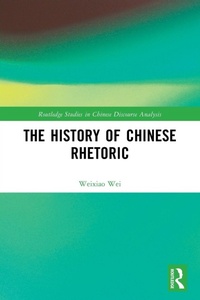
The History of Chinese Rhetoric
1st Edition
Published on 29. January 2024
Book
Paperback/Softback
148 pages
978-1-032-07275-3 (ISBN)
Description
This book challenges the existing misconception that there was no rhetoric in ancient China. Instead, this book provides ample evidence from public speeches in the Xia dynasty and oracle bone inscriptions in the Shang dynasty to public debates about government policies in the Han dynasty to show that persuasive discourse and rudimentary rhetorical techniques already existed in ancient China.
Using literary analysis and discourse analysis methods, this book explains how the Mandate of Heaven was inscribed at the core of Chinese rhetoric and has guided Chinese thoughts and expressions for centuries. This book also demonstrates Chinese rhetorical wisdom by extracting many concepts and terms related to language expression, persuasive speech, morality and virtue, life and philosophy, and so on from great Chinese literary works. Well-known names, such as Confucius, Laozi, Sima Qian, Liu Xie, Mozi, Hanfeizi, Guibuzi and so on, are all touched upon with their famous theory and sayings related to and explicated from the rhetorical perspective. Many surprising facts are found by the author and revealed in the book. For example, a thousand years ago, the Chinese author Liu Xie already found that all words have preferred lexical neighbors and structural environment. This is later on 'discovered' by corpus linguistics and illustrated, for example, by the concepts of collocation and pattern grammar.
This book targets postgraduate students, teachers, researchers and scholars interested in advanced Chinese language and Chinese literature, history, and culture.
Using literary analysis and discourse analysis methods, this book explains how the Mandate of Heaven was inscribed at the core of Chinese rhetoric and has guided Chinese thoughts and expressions for centuries. This book also demonstrates Chinese rhetorical wisdom by extracting many concepts and terms related to language expression, persuasive speech, morality and virtue, life and philosophy, and so on from great Chinese literary works. Well-known names, such as Confucius, Laozi, Sima Qian, Liu Xie, Mozi, Hanfeizi, Guibuzi and so on, are all touched upon with their famous theory and sayings related to and explicated from the rhetorical perspective. Many surprising facts are found by the author and revealed in the book. For example, a thousand years ago, the Chinese author Liu Xie already found that all words have preferred lexical neighbors and structural environment. This is later on 'discovered' by corpus linguistics and illustrated, for example, by the concepts of collocation and pattern grammar.
This book targets postgraduate students, teachers, researchers and scholars interested in advanced Chinese language and Chinese literature, history, and culture.
More details
Series
Language
English
Place of publication
London
United Kingdom
Publishing group
Taylor & Francis Ltd
Illustrations
5 s/w Abbildungen, 4 s/w Photographien bzw. Rasterbilder, 1 s/w Zeichnung
1 Line drawings, black and white; 4 Halftones, black and white; 5 Illustrations, black and white
Dimensions
Height: 234 mm
Width: 156 mm
Thickness: 9 mm
Weight
248 gr
ISBN-13
978-1-032-07275-3 (9781032072753)
Copyright in bibliographic data and cover images is held by Nielsen Book Services Limited or by the publishers or by their respective licensors: all rights reserved.
Schweitzer Classification
Other editions
Additional editions
Weixiao Wei
The History of Chinese Rhetoric
E-Book
07/2022
1st Edition
Routledge
€55.49
Available for download
Weixiao Wei
The History of Chinese Rhetoric
E-Book
07/2022
1st Edition
Routledge
€55.49
Available for download
Weixiao Wei
The History of Chinese Rhetoric
Book
07/2022
1st Edition
Routledge
€205.80
Shipment within 10-20 days
Person
Weixiao Wei has been working with Taiyuan University of Technology as a lecturer at the College of Foreign Languages and Literatures for nine years since she obtained her MA degree in 2010. In July 2017, she obtained a visiting scholarship from the China Scholarship Council (CSC) to visit Swansea University, UK, for a year. Since then, she has published a monograph and five book chapters with Routledge. In addition to preparing research papers and edited volumes for further publication, she has been pursuing her PhD study in rhetoric and composition at the University of Houston since 2020.
Content
Introduction
Chapter 1. Rhetoric in the West versus Xiuci in Chinese history
Chapter 2. Rhetoric of OBI and Inscriptions on Bronzes in Shang-Western Zhou (1600-771 BC)
Chapter 3. Rhetoric of the Eastern Zhou (770-256 BC)
Chapter 4. Rhetoric of Han-Jin Dynasties
Chapter 5. Rhetoric of Tang-Song Dynasties
Chapter 6. Yuan-Ming-Qing Dynasties
Index
Chapter 1. Rhetoric in the West versus Xiuci in Chinese history
Chapter 2. Rhetoric of OBI and Inscriptions on Bronzes in Shang-Western Zhou (1600-771 BC)
Chapter 3. Rhetoric of the Eastern Zhou (770-256 BC)
Chapter 4. Rhetoric of Han-Jin Dynasties
Chapter 5. Rhetoric of Tang-Song Dynasties
Chapter 6. Yuan-Ming-Qing Dynasties
Index