

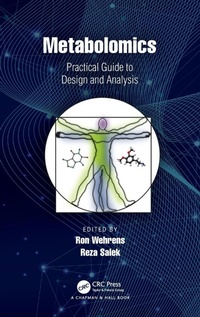
Metabolomics
Practical Guide to Design and Analysis
1st Edition
Published on 21. August 2019
Book
Hardback
276 pages
978-1-4987-2526-2 (ISBN)
Description
Metabolomics is the scientific study of the chemical processes in a living system, environment and nutrition. It is a relatively new omics science, but the potential applications are wide, including medicine, personalized medicine and intervention studies, food and nutrition, plants, agriculture and environmental science. The topics presented and discussed in this book are based on the European Molecular Biology Organization (EMBO) practical courses in metabolomics bioinformatics taught to those working in the field, from masters to postgraduate students, PhDs, postdoctoral and early PIs. The book covers the basics and fundamentals of data acquisition and analytical technologies, but the primary focus is data handling and data analysis. The mentioning and usage of a particular data analysis tool has been avoided; rather, the focus is on the concepts and principles of data processing and analysis. The material has been class-tested and includes lots of examples, computing and exercises.
Key Features:
Provides an overview of qualitative /quantitative methods in metabolomics
Offers an introduction to the key concepts of metabolomics, including experimental design and technology
Covers data handling, processing, analysis, data standards and sharing
Contains lots of examples to illustrate the topics
Includes contributions from some of the leading researchers in the field of metabolomics with extensive teaching experiences
Key Features:
Provides an overview of qualitative /quantitative methods in metabolomics
Offers an introduction to the key concepts of metabolomics, including experimental design and technology
Covers data handling, processing, analysis, data standards and sharing
Contains lots of examples to illustrate the topics
Includes contributions from some of the leading researchers in the field of metabolomics with extensive teaching experiences
More details
Series
Language
English
Place of publication
Oxford
United States
Publishing group
Taylor & Francis Inc
Target group
College/higher education
Professional and scholarly
Illustrations
11 s/w Abbildungen, 55 farbige Abbildungen, 4 s/w Photographien bzw. Rasterbilder, 66 s/w Zeichnungen, 6 s/w Tabellen
6 Tables, black and white; 66 Line drawings, black and white; 4 Halftones, black and white; 55 Illustrations, color; 11 Illustrations, black and white
Dimensions
Height: 240 mm
Width: 161 mm
Thickness: 20 mm
Weight
602 gr
ISBN-13
978-1-4987-2526-2 (9781498725262)
Copyright in bibliographic data and cover images is held by Nielsen Book Services Limited or by the publishers or by their respective licensors: all rights reserved.
Schweitzer Classification
Other editions
Additional editions
Book
12/2021
1st Edition
Chapman & Hall/CRC
€96.20
Shipment within 10-20 days
E-Book
08/2019
1st Edition
Chapman & Hall/CRC
€68.49
Available for download
E-Book
08/2019
1st Edition
Chapman & Hall/CRC
€68.49
Available for download
Persons
Ron Wehrens was an associate professor at the Radboud University Nijmegen (Netherlands) before founding the Biostatistics unit at the Fondazione Edmund Mach, San Michele all'Adige (Italy). Currently, he is Business Unit Manager at Biometris, Wageningen University & Research, Netherlands.
Reza Salek* has worked in the past in the University of Cambridge and The European Molecular Biology Laboratory European Bioinformatics Institute (EMBL EBI), Cambridge UK. He is currently scientist at The International Agency for Research on Cancer, an intergovernmental agency forming part of the World Health Organization of the United Nations, Lyon France.
*Where authors are identified as personnel of the International Agency for Research on Cancer / World Health Organization, the authors alone are responsible for the views expressed in this article and they do not necessarily represent the decisions, policy or views of the International Agency for Research on Cancer / World Health Organization
Reza Salek* has worked in the past in the University of Cambridge and The European Molecular Biology Laboratory European Bioinformatics Institute (EMBL EBI), Cambridge UK. He is currently scientist at The International Agency for Research on Cancer, an intergovernmental agency forming part of the World Health Organization of the United Nations, Lyon France.
*Where authors are identified as personnel of the International Agency for Research on Cancer / World Health Organization, the authors alone are responsible for the views expressed in this article and they do not necessarily represent the decisions, policy or views of the International Agency for Research on Cancer / World Health Organization
Content
Part I - Setting the stage. What is metabolomics, definitions. Before you start. Measurement technologies. A short review of applications of metabolomics in different fields, to whet the appetite. Part II - Data processing. NMR. MS, same topics as with NMR. LCDAD. Part III - From data to information. A short review of relevant statistical techniques. Statistical analysis for platforms separately. Data fusion. Metabolic networks. Metabolic flux. Part IV- Data sharing. Data storage and accessibility. Data standards and databases of standards. Conclusion - what is next in metabolomics? Where are the bottlenecks in the bioinformatics part?