

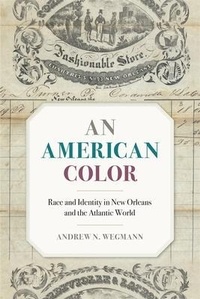
An American Color
Race and Identity in New Orleans and the Atlantic World
Published on 15. January 2022
Book
Paperback/Softback
258 pages
978-0-8203-6078-2 (ISBN)
Description
For decades, scholars have conceived of the coastal city of New Orleans as a remarkable outlier, an exception to nearly every "rule" of accepted U.S. historiography. A frontier town of the circum-Caribbean, the popular image of New Orleans has remained a vestige of North America's European colonial era rather than an Atlantic city on the southern coast of the United States.
Beginning with the French founding of New Orleans in 1718 and concluding with the outbreak of the American Civil War in 1861, An American Color seeks to correct this vision. By tracing the impact of racial science, law, and personal reputation and identity through multiple colonial and territorial regimes, it shows how locally born mulatres in French New Orleans became part of a self-conscious, identifiable community of Creoles of color in the United States. An American Color places this local history in the wider context of the North American continent and the Atlantic world. This book shows that New Orleans and its free population of color did not develop in a cultural, legal, or intellectual vacuum. More than just a study of race and law, this work tells a story of humanity in the Atlantic world, a story of how a people on the French colonial frontier in the mid-eighteenth century became unlikely, accepted parts of a vast political, social, and racial United States without ever leaving home.
Beginning with the French founding of New Orleans in 1718 and concluding with the outbreak of the American Civil War in 1861, An American Color seeks to correct this vision. By tracing the impact of racial science, law, and personal reputation and identity through multiple colonial and territorial regimes, it shows how locally born mulatres in French New Orleans became part of a self-conscious, identifiable community of Creoles of color in the United States. An American Color places this local history in the wider context of the North American continent and the Atlantic world. This book shows that New Orleans and its free population of color did not develop in a cultural, legal, or intellectual vacuum. More than just a study of race and law, this work tells a story of humanity in the Atlantic world, a story of how a people on the French colonial frontier in the mid-eighteenth century became unlikely, accepted parts of a vast political, social, and racial United States without ever leaving home.
Reviews / Votes
An American Color is a brilliant tour de force of research and consummate scholarship. . . . Andrew N. Wegmann's ability to wend a pathway through bodies of law and literature in French, Spanish, and English traditions is superb. -- Larry Tise * coeditor of New Voyages to Carolina: Reinterpreting North Carolina History * Andrew N. Wegmann's ambitious and wide-ranging study is firmly grounded in the complex history of New Orleans as it moved through its Spanish, French, and American phases. Unlike previous studies which tend to focus on one of those periods, he traces the changing definitions of race as they mutated across time, and he looks outward from the city to the larger Caribbean, Atlantic, and U.S. contexts that impacted concepts of race in New Orleans. Wegmann demonstrates how those legal, social, and cultural concepts played out in the lives of the city's mixed-race community. Given his engagement with concepts of race across the French, Spanish, and Anglo-Atlantic worlds, the book has wide appeal. Deeply researched, beautifully written, and concise, the book will engage academics, students, and non-academics alike. -- Randy J. Sparks, professor of history, Tulane University * author of Africans in the Old South: Mapping Exceptional Lives across the Atlantic World * The layers of imperial and national histories in New Orleans have made the city both distinct and universal. In his study of the Creole elite, Andrew N. Wegmann weaves seamlessly between individual narratives and broader cultural and legal changes, showing how each shaped or defied the other. This indispensable history of race and racism in the United States reveals Atlantic connections and context as well as local specificity of geography, chronology, and human agency. -- Julia Gaffield * author of Haitian Connections in the Atlantic World: Recognition after Revolution * An American Color seeks to demystify ideas about race in New Orleans by situating the city, not as a unique exception to other southern coastal cities, but as one with deep roots and an important role in the evolving Atlantic World. . . . The volume is rich in primary sources and speaks in many voices to suss out changing legal and scientific ideas about race, as well as more personal issues related to race, social class, and reputation. Wegmann expertly carries readers along with him as he highlights and clarifies local New Orleanian social constructs and relates them to changes in both continental and Atlantic political and social structures that affected ideas related to race and racial identity. -- S.L. Kwosek * CHOICE * A skillful navigation of the legal discourses surrounding race across two centuries and three colonial regimes. -- Darryl G. Barthe * Journal of Southern History *More details
Series
Language
English
Place of publication
Georgia
United States
Target group
Professional and scholarly
Product notice
Paperback (trade)
Unsewn / adhesive bound
Dimensions
Height: 229 mm
Width: 152 mm
Thickness: 15 mm
Weight
386 gr
ISBN-13
978-0-8203-6078-2 (9780820360782)
Copyright in bibliographic data and cover images is held by Nielsen Book Services Limited or by the publishers or by their respective licensors: all rights reserved.
Schweitzer Classification
Other editions
Additional editions
E-Book
01/2022
University of Georgia Press
€31.99
Available for download
Person
ANDREW N. WEGMANN is associate professor of history at Delta State University, where he teaches classes on the early American republic and the Atlantic world. He is coauthor, with Sara K. Eskridge, of U.S. History: A Top Hat Interactive Text and coeditor, with Robert Englebert, of French Connections: Cultural Mobility in North America and the Atlantic World. A native of New Orleans, he lives in Cleveland, Mississippi.