

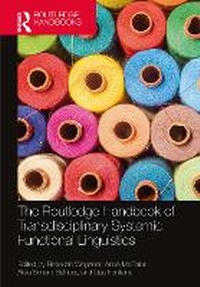
The Routledge Handbook of Transdisciplinary Systemic Functional Linguistics
1st Edition
Will be published approx. on 30. April 2027
Book
Paperback/Softback
484 pages
978-1-032-27059-3 (ISBN)
Description
The Routledge Handbook of Transdisciplinary Systemic Functional Linguistics offers a groundbreaking exploration of how M.A.K. Halliday's influential work extends beyond traditional linguistic boundaries to address today's most complex problems.
A key barrier to transdisciplinary research is language, whether due to differing terminology or the lack of a shared research vocabulary. This challenge reflects deeper epistemological divides, as language shapes how knowledge is constructed and communicated across disciplines. This collection shows how Systemic Functional Linguistics (SFL) provides effective tools for addressing complex cross-disciplinary issues. Beginning with Halliday's foundational work, it traces the development of SFL and its applications. The first section highlights how SFL supports meaning-making in areas such as child development and healthcare, emphasizing language's role in identity. Later sections explore its use in political, cultural, and environmental contexts, as well as in technology and AI. The volume concludes by outlining how language theory can help address critical societal challenges through interdisciplinary collaboration.
This book a valuable resource for students and scholars in applied linguistics, SFL, forensic linguistics, computational linguistics, and language and communication.
A key barrier to transdisciplinary research is language, whether due to differing terminology or the lack of a shared research vocabulary. This challenge reflects deeper epistemological divides, as language shapes how knowledge is constructed and communicated across disciplines. This collection shows how Systemic Functional Linguistics (SFL) provides effective tools for addressing complex cross-disciplinary issues. Beginning with Halliday's foundational work, it traces the development of SFL and its applications. The first section highlights how SFL supports meaning-making in areas such as child development and healthcare, emphasizing language's role in identity. Later sections explore its use in political, cultural, and environmental contexts, as well as in technology and AI. The volume concludes by outlining how language theory can help address critical societal challenges through interdisciplinary collaboration.
This book a valuable resource for students and scholars in applied linguistics, SFL, forensic linguistics, computational linguistics, and language and communication.
More details
Series
Language
English
Place of publication
London
United Kingdom
Publishing group
Taylor & Francis Ltd
Target group
College/higher education
Professional and scholarly
Postgraduate
Illustrations
18 s/w Photographien bzw. Rasterbilder, 55 s/w Abbildungen, 34 s/w Tabellen, 37 s/w Zeichnungen
34 Tables, black and white; 37 Line drawings, black and white; 18 Halftones, black and white; 55 Illustrations, black and white
Dimensions
Height: 254 mm
Width: 178 mm
ISBN-13
978-1-032-27059-3 (9781032270593)
Copyright in bibliographic data and cover images is held by Nielsen Book Services Limited or by the publishers or by their respective licensors: all rights reserved.
Schweitzer Classification
Other editions
Additional editions
Rebekah Wegener | Anne McCabe | Akila Sellami Baklouti
The Routledge Handbook of Transdisciplinary Systemic Functional Linguistics
E-Book
12/2025
1st Edition
Routledge
€68.49
Available for download
Rebekah Wegener | Anne McCabe | Akila Sellami Baklouti
The Routledge Handbook of Transdisciplinary Systemic Functional Linguistics
Book
approx. 12/2025
1st Edition
Routledge
€331.90
Not yet published
Rebekah Wegener | Anne McCabe | Akila Sellami Baklouti
The Routledge Handbook of Transdisciplinary Systemic Functional Linguistics
E-Book
12/2025
1st Edition
Routledge
€68.49
Available for download
Persons
Rebekah Wegener is Associate Professor in Applied Linguistics at the University of Salzburg, Austria. Drawing on functional approaches to language, her research connects theoretical frameworks with applications through multimodal interaction across contexts, computer-mediated communication, and human-computer interaction. Bridging linguistics and practical applications, she explores human-centered and explainable AI in medical and educational domains.
Anne McCabe is Professor Emerita of English at Saint Louis University's Madrid Campus, where she has taught courses in rhetoric, academic writing, linguistics, public speaking, and English as an additional language. Her research focuses mainly on linguistics applied to language education and she is a member of the UAM-CLIL research group (http://www.uam-clil.org).
Akila Sellami Baklouti is a Professor of English Language and ?Linguistics at the Faculty of Arts and Humanities of Sfax (Tunisia). She mainly lectures on systemic functional grammar, academic writing, and research methodology. Her ?research interests and PhD supervision areas include Systemic Functional Linguistics, genre analysis, and genre-based contrastive and translation studies.
Lise Fontaine is a Professor in the Department of Lettres et Communication Sociale at the Universite du Quebec a Trois-Rivieres (UQTR), and also serves as Director of the undergraduate program committee. Her academic work is centred on linguistic theory, with specific interests in functional grammar, lexicons-grammar, semantics, and referring expressions. Fontaine applies linguistic approaches in interdisciplinary contexts as well.
Anne McCabe is Professor Emerita of English at Saint Louis University's Madrid Campus, where she has taught courses in rhetoric, academic writing, linguistics, public speaking, and English as an additional language. Her research focuses mainly on linguistics applied to language education and she is a member of the UAM-CLIL research group (http://www.uam-clil.org).
Akila Sellami Baklouti is a Professor of English Language and ?Linguistics at the Faculty of Arts and Humanities of Sfax (Tunisia). She mainly lectures on systemic functional grammar, academic writing, and research methodology. Her ?research interests and PhD supervision areas include Systemic Functional Linguistics, genre analysis, and genre-based contrastive and translation studies.
Lise Fontaine is a Professor in the Department of Lettres et Communication Sociale at the Universite du Quebec a Trois-Rivieres (UQTR), and also serves as Director of the undergraduate program committee. Her academic work is centred on linguistic theory, with specific interests in functional grammar, lexicons-grammar, semantics, and referring expressions. Fontaine applies linguistic approaches in interdisciplinary contexts as well.
Content
Part 0: A View to Transdisciplinarity - 1: On the Nature of Linguistics and its Transdisciplinary Potential, Rebekah Wegener, Lise Fontaine, Anne McCabe; 2: SFL and Functional Models of Language: Multidisciplinarity or Transdisciplinarity?, Jacques Francois and Akila Sellami Baklouti. Part I: The Individual in a Transdisciplinary Perspective - 3: Child Language Development, Clare Painter & Susan Feez; 4: Working Transdisciplinarily in Content and Language Integrated Learning Programs, Ana Llinares, Rachel Whittaker, Tom Morton; 5: Transdisciplinary SFL Praxis with Multilingual Youth and Educators, Ruth Harman, Xiaodong Zhang, Dan Jin; 6: Bilingual Strata: Neurocognitive Insights for Systemic Functional Linguistics, Matias Morales, Edinson Munoz, Adolfo M. Garcia; 7: Conceptual Metaphor Between Universality and Variation: An SFL Perspective on Context, Fatma Benelhadj; 8: Clinical Linguistics: A Focus on Interactions and an Interpersonal Perspective, Elizabeth Armstrong, Rimke Groenewold, Deborah Hersh, Christa Akers, Mary-Pat O'Malley, Nicole Muller; 9: Language in Affective Disorders: The Opportunities of a Functional Approach, Jamie Williams. Part II: Social Processes in a Transdisciplinary Perspective - 10: Thematic and Methodological Transdisciplinarity in SFL-related Studies of Ideology, Erich Steiner; 11: Ecolinguistics and the Rethinking of Society: From Grammar to Narrative, Arran Stibbe; 12: A Transdisciplinary Study of Language Reports Across Registerial Variation, Nesrine Triki; 13: Transdisciplinary Approaches in Translation Studies Empowered by Systemic Functional Linguistics, Bo Wang, Christian M.I.M. Matthiessen, Yuanyi Ma; 14: "When Language Becomes the Evidence...": An Analysis of the TRANSITIVITY Patterns in Two High-profile Criminal Trials of the 1990s, Leanne Bartley; 15: Functional(ist) Approaches to Promotional Discourse, Hartmut Stoeckl; 16: Towards a Transdisciplinary Approach to the Analysis of the Digital Text of Software Installation, Dorra Moalla; 17: Halliday's Transdisciplinarity Meets Hasan's Systemic Socio-Semantic Stylistics (SSS): Exploratory Reflections, Donna R. Miller. Part III: Tools and Technology in a Transdisciplinary Perspective - 18: Transdisciplinary Research on Language Behaviour in Situational Context, Stella Neumann; 19: Register Revisited: Information Theory as a Bridge Between Functional Description and Cognitive Explanation, Stefania Degaetano-Ortlieb, Elke Teich; 20: Systemic Transdisciplinary Theory of Cross-disciplinary Social Research Method Appropriation: Face-to-face Interviewing, Rodney J. Clarke; 21: The Future of Morphology: A Transdisciplinary Approach, Kateryna Krykoniuk; 22: Knowledge Graphs for Digital Humanities and Linguistics, Krzysztof Kutt, Luiz do Valle Miranda, Jakub Gomulka, Ricardo Alonso-Maturana, Susana Lopez-Sola, Jose Palma, Grzegorz J. Nalepa; 23: Form and Function: Automatic Methods for Prediction of Functions, Serge Sharoff; 24: Linguistics and Artificial Intelligence - A Match Made in Heaven for Solving Real Business Problems, August Stapput, Anders Kofod-Petersen; 25: Transdisciplinary Perspectives on Human-Computer Interaction and Artificial Intelligence, Joerg Cassens. Part IV: Reflections on Transdisciplinarity - 26: Transdisciplinarity Within Systemic Functional Linguistics, Christian M.I.M. Matthiessen; 27: Epilogue: Rebekah Wegener, Anne McCabe, Akila Sellami Baklouti, Lise Fontaine.