

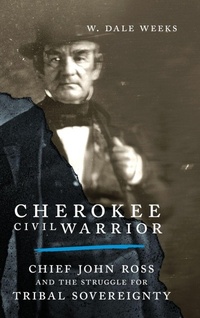
Cherokee Civil Warrior
Chief John Ross and the Struggle for Tribal Sovereignty
Published on 16. February 2023
Book
Hardback
246 pages
978-0-8061-9157-7 (ISBN)
Description
For the Cherokee Nation, the Civil War was more than a contest between the Union and the Confederacy. It was yet another battle in the larger struggle against multiple white governments for land and tribal sovereignty. Cherokee Civil Warrior tells the story of Chief John Ross as he led the tribe in this struggle.
The son of a Scottish father and mixed-blood Indian mother, John Ross served the Cherokee Nation in a public capacity for nearly fifty years, thirty-eight as its constitutionally elected principal chief. Historian W. Dale Weeks describes Ross's efforts to protect the tribe's interests amid systematic attacks on indigenous culture throughout the nineteenth century, from the forced removal policies of the 1830s to the exigencies of the Civil War era. At the outset of the Civil War, Ross called for all Cherokees, slaveholding and nonslaveholding, to remain neutral in a war they did not support-a position that became untenable when the United States withdrew its forces from Indian Territory. The vacated forts were quickly occupied by Confederate troops, who pressured the Cherokees to align with the South.
Viewed from the Cherokee perspective, as Weeks does in this book, these events can be seen in their proper context, as part of the history of U.S. "Indian policy," failed foreign relations, and the Anglo-American conquest of the American West. This approach also clarifies President Abraham Lincoln's acknowledgment of the federal government's abrogation of its treaty obligation and his commitment to restoring political relations with the Cherokees-a commitment abruptly ended when his successor Andrew Johnson instead sought to punish the Cherokees for their perceived disloyalty.
Centering a Native point of view, this book recasts and expands what we know about John Ross, the Cherokee Nation, its commitment to maintaining its sovereignty, and the Civil War era in Indian Territory. Weeks also provides historical context for later developments, from the events of Little Bighorn and Wounded Knee to the struggle over tribal citizenship between the Cherokees and the descendants of their former slaves.
The son of a Scottish father and mixed-blood Indian mother, John Ross served the Cherokee Nation in a public capacity for nearly fifty years, thirty-eight as its constitutionally elected principal chief. Historian W. Dale Weeks describes Ross's efforts to protect the tribe's interests amid systematic attacks on indigenous culture throughout the nineteenth century, from the forced removal policies of the 1830s to the exigencies of the Civil War era. At the outset of the Civil War, Ross called for all Cherokees, slaveholding and nonslaveholding, to remain neutral in a war they did not support-a position that became untenable when the United States withdrew its forces from Indian Territory. The vacated forts were quickly occupied by Confederate troops, who pressured the Cherokees to align with the South.
Viewed from the Cherokee perspective, as Weeks does in this book, these events can be seen in their proper context, as part of the history of U.S. "Indian policy," failed foreign relations, and the Anglo-American conquest of the American West. This approach also clarifies President Abraham Lincoln's acknowledgment of the federal government's abrogation of its treaty obligation and his commitment to restoring political relations with the Cherokees-a commitment abruptly ended when his successor Andrew Johnson instead sought to punish the Cherokees for their perceived disloyalty.
Centering a Native point of view, this book recasts and expands what we know about John Ross, the Cherokee Nation, its commitment to maintaining its sovereignty, and the Civil War era in Indian Territory. Weeks also provides historical context for later developments, from the events of Little Bighorn and Wounded Knee to the struggle over tribal citizenship between the Cherokees and the descendants of their former slaves.
Reviews / Votes
"Cherokee Civil Warrior boldly places Chief John Ross at the center of the political struggle for Native sovereignty, recognizing the impact of his leadership far beyond Removal and the Civil War. It offers a fresh approach to fathoming the drastic changes in federal Indian policy at the end of the nineteenth century by looking through the lens of Cherokee autonomy."-Clarrissa Confer, author of The Cherokee Nation in the Civil WarMore details
Language
English
Place of publication
Oklahoma
United States
Product notice
Cloth over boards
Illustrations
1 b&w illus., 3 maps
Dimensions
Height: 235 mm
Width: 157 mm
Thickness: 19 mm
Weight
555 gr
ISBN-13
978-0-8061-9157-7 (9780806191577)
Copyright in bibliographic data and cover images is held by Nielsen Book Services Limited or by the publishers or by their respective licensors: all rights reserved.
Schweitzer Classification
Person
W. Dale Weeks is a History Instructor at Blinn College in Bryan, Texas. He holds a PhD in history from Texas A&M University.