

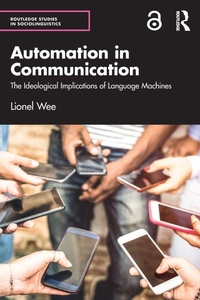
Automation in Communication
The Ideological Implications of Language Machines
1st Edition
Published on 19. September 2024
Book
Paperback/Softback
160 pages
978-1-032-73223-7 (ISBN)
Description
By drawing on multiple examples from healthcare, religion, service encounters and poetry, Lionel Wee presents rich insights into the use of automation in communication through a posthumanist lens.
As communication becomes increasingly automated, the use of automation creates significant conceptual challenges for ideologies about language, beliefs about the nature of language, as well as assumptions about the roles that interpretation, anthropomorphism, and folk theories of mind play when language is used in communication. This book unravels the ideological implications of automation in communication and provides a new theoretical ground to address the major issues raised by automation. Wee discusses the importance of thinking carefully about how we identify and distinguish the roles of speaker and hearer. He also argues that we re-evaluate our understanding of the relationship between language and community.
This book will be vital to students interested in studying the intersections of AI, language and communication, as well as researchers working in communication studies, linguistics and the broader sociology of language in the age of technological change.
As communication becomes increasingly automated, the use of automation creates significant conceptual challenges for ideologies about language, beliefs about the nature of language, as well as assumptions about the roles that interpretation, anthropomorphism, and folk theories of mind play when language is used in communication. This book unravels the ideological implications of automation in communication and provides a new theoretical ground to address the major issues raised by automation. Wee discusses the importance of thinking carefully about how we identify and distinguish the roles of speaker and hearer. He also argues that we re-evaluate our understanding of the relationship between language and community.
This book will be vital to students interested in studying the intersections of AI, language and communication, as well as researchers working in communication studies, linguistics and the broader sociology of language in the age of technological change.
More details
Series
Language
English
Place of publication
London
United Kingdom
Publishing group
Taylor & Francis Ltd
Target group
College/higher education
Professional and scholarly
Academic, Postgraduate, and Undergraduate Advanced
Dimensions
Height: 234 mm
Width: 156 mm
Thickness: 9 mm
Weight
263 gr
ISBN-13
978-1-032-73223-7 (9781032732237)
Copyright in bibliographic data and cover images is held by Nielsen Book Services Limited or by the publishers or by their respective licensors: all rights reserved.
Schweitzer Classification
Other editions
Additional editions
E-Book
09/2024
Routledge
€43.49
Available for download
E-Book
09/2024
Routledge
€43.49
Available for download
Book
09/2024
1st Edition
Routledge
€231.20
Shipment within 10-20 days
Person
Lionel Wee is a Provost's Chair Professor in the Department of English, Linguistics and Theatre Studies Dean of the Faculty of Arts and Social Sciences at the National University of Singapore. He sits on the editorial boards of the Journal of Sociolinguistics, Applied Linguistics, English World-Wide, Sociolinguistic Studies, Multilingual Margins and Studies in World Language Problems.
Content
1. Machines Are Talking ... But Are They Actually Speaking? 2. Laying the Groundwork: Posthumanism, Boundaries, and Assemblages 3. The Death of the Speaker 4. A Hearer-Based Pragmatics 5. Gradations of Anthropomorphism 6. Creativity and Heritage: Two Elephants in the Room 7. Towards Posthumanist Organizations 8. Assemblages and the Emergence of Language from Communication