

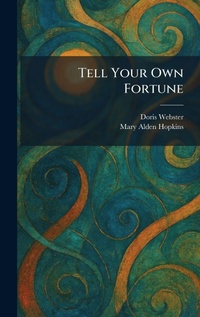
Tell Your Own Fortune
Description
"Tell Your Own Fortune" is an engaging and whimsical guide to the popular arts of divination and character analysis that captivated audiences in the early twentieth century. Written by Doris Webster and Mary Alden Hopkins, this work serves as an interactive manual for readers seeking to explore their personal destinies and hidden personality traits through various lighthearted methods.
Reflecting the era's vibrant interest in parlor games and psychological self-discovery, the book offers a series of questions and systems designed to provide insight into one's future and temperament. It bridges the gap between mystical tradition and social entertainment, making the practice of fortune-telling accessible to a general audience. Whether used for solo reflection or as a social activity, "Tell Your Own Fortune" provides a charming window into historical beliefs about luck, personality, and the desire to glimpse what lies ahead.
This work remains a significant example of early-century popular culture, illustrating how themes of fate and self-identity were explored in the domestic sphere. It is an ideal read for those interested in the history of the occult, social pastimes, or the evolution of the self-help genre.
This work has been selected by scholars as being culturally important, and is part of the knowledge base of civilization as we know it. This work was reproduced from the original artifact, and remains as true to the original work as possible. Therefore, you may see the original copyright references, library stamps (as most of these works have been housed in our most important libraries around the world), and other notations in the work.
This work is in the public domain in the United States of America, and possibly other nations. Within the United States, you may freely copy and distribute this work, as no entity (individual or corporate) has a copyright on the body of the work.
As a reproduction of a historical artifact, this work may contain missing or blurred pages, poor pictures, errant marks, etc. Scholars believe, and we concur, that this work is important enough to be preserved, reproduced, and made generally available to the public. We appreciate your support of the preservation process, and thank you for being an important part of keeping this knowledge alive and relevant.