

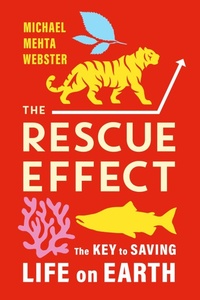
The Rescue Effect
The Key to Saving Life on Earth
Published on 23. May 2024
Book
Paperback/Softback
304 pages
978-1-64326-397-7 (ISBN)
Description
"Details profound examples of life's resilience and makes a convincing case that the natural world still has a lot worth fighting for." -Paul Greenberg, New York Times bestselling author of Four Fish and The Climate Diet
As climate change continues to intensify, the outlook for life on Earth often seems bleak. Yet hope for the future can be found in the "rescue effect," which is nature's innate ability to help organisms persist during hard times. Like a thermostat starting the air conditioning when a room gets too warm, the rescue effect automatically kicks in when organisms are stressed or declining.
In The Rescue Effect, Michael Mehta Webster reveals the science behind nature's inherent resilience, through compelling stories of species that are adapting to the changing world-including tigers in the jungles of India, cichlid fish in the great lakes of Africa, and corals in the Caribbean. In some cases, like the mountain pygmy-possum in the snowy mountains of southeast Australia, we risk losing species without intensive help from people. As observers to-and the cause of-species declines, we must choose whether and how to help, while navigating challenging questions about emerging technologies and the ethics of conservation actions.
Ultimately, Webster argues that there are good reasons to expect a bright future, because everywhere we look, we can see evidence that nature can rescue many species from extinction; and when nature alone is not up to the task, we can help. Combining rigorous research with gripping storytelling, The Rescue Effect provides the cautious optimism we need to help save life on Earth.
As climate change continues to intensify, the outlook for life on Earth often seems bleak. Yet hope for the future can be found in the "rescue effect," which is nature's innate ability to help organisms persist during hard times. Like a thermostat starting the air conditioning when a room gets too warm, the rescue effect automatically kicks in when organisms are stressed or declining.
In The Rescue Effect, Michael Mehta Webster reveals the science behind nature's inherent resilience, through compelling stories of species that are adapting to the changing world-including tigers in the jungles of India, cichlid fish in the great lakes of Africa, and corals in the Caribbean. In some cases, like the mountain pygmy-possum in the snowy mountains of southeast Australia, we risk losing species without intensive help from people. As observers to-and the cause of-species declines, we must choose whether and how to help, while navigating challenging questions about emerging technologies and the ethics of conservation actions.
Ultimately, Webster argues that there are good reasons to expect a bright future, because everywhere we look, we can see evidence that nature can rescue many species from extinction; and when nature alone is not up to the task, we can help. Combining rigorous research with gripping storytelling, The Rescue Effect provides the cautious optimism we need to help save life on Earth.
More details
Language
English
Place of publication
United States
Publishing group
Workman Publishing
Target group
College/higher education
Professional and scholarly
Product notice
Paperback (UK-trade)
Dimensions
Height: 234 mm
Width: 160 mm
Thickness: 23 mm
Weight
318 gr
ISBN-13
978-1-64326-397-7 (9781643263977)
Copyright in bibliographic data and cover images is held by Nielsen Book Services Limited or by the publishers or by their respective licensors: all rights reserved.
Schweitzer Classification
Person
Michael Mehta Webster is an expert in ecology, conservation, philanthropy, and non-profit management. His research interests focus on how organisms and ecosystems adapt to environmental change, how this information can be translated into effective conservation strategies, and the practical and ethical dilemmas that arise along the way. As an executive director of a conservation organization, program officer at a leading environmental foundation, and academic scientist, he has led efforts to connect cutting edge science to the management of species and ecosystems in the wild.