


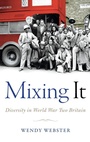
Mixing It
Diversity in World War Two Britain
Published on 29. October 2020
Book
Paperback/Softback
336 pages
978-0-19-289521-9 (ISBN)
Description
During the Second World War, people arrived in Britain from all over the world as troops, war-workers, nurses, refugees, exiles, and prisoners-of-war-chiefly from Europe, America, and the British Empire. Between 1939 and 1945, the population in Britain became more diverse than it had ever been before.
Through diaries, letters, and interviews, Mixing It tells of ordinary lives pushed to extraordinary lengths. Among the stories featured are those of Zbigniew Siemaszko - deported by the Soviet Union, fleeing Kazakhstan on a horse-drawn sleigh, and eventually joining the Polish army in Scotland via Iran, Iraq, and South Africa - and 'Johnny' Pohe - the first Maori pilot to serve in the RAF, who was captured, and eventually murdered by the Gestapo for his part in the 'Great Escape'.
This is the first book to look at the big picture of large-scale movements to Britain and the rich variety of relations between different groups. When the war ended, awareness of the diversity of Britain's wartime population was lost and has played little part in public memories of the war. Mixing It recovers this forgotten history. It illuminates the place of the Second World War in the making of multinational, multiethnic Britain and resonates with current debates on immigration.
Through diaries, letters, and interviews, Mixing It tells of ordinary lives pushed to extraordinary lengths. Among the stories featured are those of Zbigniew Siemaszko - deported by the Soviet Union, fleeing Kazakhstan on a horse-drawn sleigh, and eventually joining the Polish army in Scotland via Iran, Iraq, and South Africa - and 'Johnny' Pohe - the first Maori pilot to serve in the RAF, who was captured, and eventually murdered by the Gestapo for his part in the 'Great Escape'.
This is the first book to look at the big picture of large-scale movements to Britain and the rich variety of relations between different groups. When the war ended, awareness of the diversity of Britain's wartime population was lost and has played little part in public memories of the war. Mixing It recovers this forgotten history. It illuminates the place of the Second World War in the making of multinational, multiethnic Britain and resonates with current debates on immigration.
Reviews / Votes
Review from previous edition Mixing It, which provides a rich and multilayered account of 'transnational mixing' (p. 12) in wartime Britain, is a welcome addition to Wendy Webster's already outstanding scholarship addressing the diverse populations of Britain during the Second World War and beyond. * Wendy Ugolini, War in History * A compelling argument, built upon a rich collection of sources; it deserves to be widely read. * Dr Henry Irving, Reviews in History * What makes Mixing It both highly readable and, on multiple pages, genuinely heartrending is the space the author dedicates to personal testimonies. Just how disconnected the myth that Britain 'stood alone' has become from the complex reality is revealed in panoramic detail and compelling human colour. The picture she paints is fresh and exhilarating, in part because the stories and the voices she has exhumed from the archives have for so long been marginalised and forgotten. * David Olusoga, New Statesman * One of the many great strengths of this book is that Webster covers the entire range of ethnic groups in Britain during the war. Another great strength lies in the way it constructs a narrative using numerous personal stories. Webster proves herself a master of the art. She has constructed a beautiful narrative that anyone working on Second World War Britain or who wants to learn the meaning of diversity should read. * Panikos Panayi, Times Higher Education * A fascinating study of official and popular responses to overseas arrivals and a population more diverse than ever before. * Paul Laity, The Guardian * Wendy Webster's new book is a rich and vivid account of the tensions and relationships forged as Britain became increasingly exposed to people from across the world. Carefully selected and often lyrically presented personal stories ... are gripping and wonderfully rendered. Mixing It uncovers an explosion of social difference rippling through the country from the town hall of Bury St. Edmunds to Llanwrtyd Wells. * Sam Wetherall, Twentieth Century British History * Wendy Webster draws on a rich range of sources and biographical life stories to describe the immigration experience and the responses of individuals in the host communities to migrants during the war years ... warmly recommended for those who wish to have an informed view of the British immigration experience during the past 80 years. * David Killingray, Family & Community History * Mixing It is both a first class scholarly history and a parable for our own day. I doubt if anyone who reads the book will ever picture the home front in quite the same way again * Paul Addison, University of Edinburgh *More details
Edition
1
Language
English
Place of publication
Oxford
United Kingdom
Target group
Professional and scholarly
Product notice
Paperback (trade)
Unsewn / adhesive bound
Illustrations
black and white illustrations
Dimensions
Height: 234 mm
Width: 155 mm
Thickness: 23 mm
Weight
522 gr
ISBN-13
978-0-19-289521-9 (9780192895219)
Copyright in bibliographic data is held by Nielsen Book Services Limited or its licensors: all rights reserved.
Schweitzer Classification
Other editions
Additional editions
Book
03/2018
Oxford University Press
€57.60
Shipment within 15-20 days
Person
Wendy Webster is Professor of Modern Cultural History at the University of Huddersfield and has published widely on twentieth-century history. She has been a Visiting Fellow at Australian National University and the University of Tasmania. Her previous books include Not A Man to Match Her: The Marketing of a Prime Minister (1990), Imagining Home (1998), and the prize-winning Englishness and Empire (2005). Mixing It is part of a wider project involving a display at Imperial War Museum North.
Content
Introduction: The 'Big Proposition'
1: 1940
2: Enemies and Neutrals
3: The Empire Comes to Britain
4: Allies
5: Language, Speech, and Sound
6: Sexual Patriotism
7: Aftermath
Bibliography
1: 1940
2: Enemies and Neutrals
3: The Empire Comes to Britain
4: Allies
5: Language, Speech, and Sound
6: Sexual Patriotism
7: Aftermath
Bibliography