

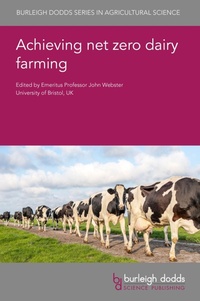
Achieving Net Zero Dairy Farming
Will be published approx. on 27. January 2026
Book
Hardback
400 pages
978-1-83545-018-5 (ISBN)
Description
To meet the targets outlined in the 2015 Paris Agreement, many countries are actively working towards reaching climate neutrality and achieving net zero by 2050. With the livestock sector estimated to contribute approximately 11-17% of global greenhouse gas emissions, more research and innovation is required to understand the cause of these emissions and how they can be reduced.
Achieving net zero dairy farming provides a detailed insight into the fundamental processes within the dairy cow and those that occur on dairy farms that contribute to and reduce greenhouse gas emissions. The book also considers the range of strategies which can be implemented to support the transition to net zero, including improving housing and housing management, supplementing diets with methane-inhibiting feed additives and optimising manure/slurry application.
More details
Series
Language
English
Place of publication
Cambridge
United Kingdom
Target group
College/higher education
Professional and scholarly
University and other researchers in dairy science, environmental scientists, dairy farmers and livestock advisors, as well as government and other agencies supporting the transition to net-zero in agriculture.
Product notice
Paper over boards
Illustrations
Color tables, photos and figures
Dimensions
Height: 235 mm
Width: 157 mm
Thickness: 28 mm
Weight
770 gr
ISBN-13
978-1-83545-018-5 (9781835450185)
DOI
10.19103/AS.2025.0157
Copyright in bibliographic data and cover images is held by Nielsen Book Services Limited or by the publishers or by their respective licensors: all rights reserved.
Schweitzer Classification
Other editions
Additional editions
John Webster
Achieving Net Zero Dairy Farming
E-Book
01/2026
Burleigh Dodds Science Publishing Limited
€196.99
Available for download
Persons
Dr John Webster is Emeritus Professor in Animal Husbandry at the University of Bristol, UK. He established the Animal Welfare and Behaviour Group at the University of Bristol, one of the largest and most highly-regarded of its kind in the world, and was a founder member of the Farm Animal Welfare Council which pioneered the Five Freedoms for farm animals. Professor Webster is editor of an earlier Burleigh Dodds Science Publishing volume: Achieving sustainable production of milk Volume 3: Dairy herd management and welfare (published in 2017). Other key books written or edited by Professor Webster include Understanding the Dairy Cow and Animal Husbandry Regained: the place of farm animals in sustainable agriculture.
Content
Part 1 Fundamentals: The dairy cow
- 1.Advances in understanding overall nutrient/energy flows within the dairy cow: Seppo Ahvenjärvi, Natural Resources Institute Finland (LUKE), Finland;
- 2.Advances in understanding protein/nitrogen processing by the dairy cow: Jeff Firkins, Ohio State University, USA;
- 3.Advances in understanding methane production in the dairy cow: Mohammed Ramin, Swedish University of Agricultural Sciences, Sweden;
Part 2 Fundamentals and measurement: Dairy farms
- 4.Assessing greenhouse gas (GHG) emissions from different types of dairy farm: C. Alan Rotz, USDA-ARS, USA;
- 5.Measuring energy use on dairy farms: Majeed Safa, Lincoln University, New Zealand;
- 6.Water use on dairy farms: António Monteiro, Polytechnic Institute of Viseu, Portugal;
- 7.Measuring methane emissions from individual dairy farms: Luis O. Tedeschi, Texas A&M University, USA;
- 8.Ways of measuring the overall carbon footprint of dairy farming: Jonathan Herron, Teagasc, Ireland;
Part 3 Strategies to achieve net zero: Supporting the dairy cow
- 9.Genetics and breeding for reduced methane emissions: Anouk van Breukelen, Wageningen University & Research, The Netherlands;
- 10.Improving individual animal productivity/feed conversion efficiency: Robin R. White, Virginia Tech, USA;
- 11.Improving housing and housing management to reduce/manage emissions and waste: Pol Llonch, Universitat Autònoma de Barcelona, Spain;
- 12.Use of methane-inhibiting feed additives/inhibitors: John Newbold, SRUC, UK;
Part 4 Strategies to achieve net zero: System-level improvements
- 13.Manure management and processing: Alice Rocha, University of California-Davis, USA;
- 14.Optimising manure/slurry application on the farm: Shabtai Bittman, Agriculture and Agri-Food Canada, Canada;
- 15.Methane utilisation on dairy farms: Sigrid Kusch-Brandt, University of Southampton, UK;
- 16.Dairy farming and water catchment management: David J. Horne, Massey University, New Zealand;
- 17.Integrating dairy farming and crop production: Susanne Wiesner, University of Wisconsin-Madison, USA;
- 1.Advances in understanding overall nutrient/energy flows within the dairy cow: Seppo Ahvenjärvi, Natural Resources Institute Finland (LUKE), Finland;
- 2.Advances in understanding protein/nitrogen processing by the dairy cow: Jeff Firkins, Ohio State University, USA;
- 3.Advances in understanding methane production in the dairy cow: Mohammed Ramin, Swedish University of Agricultural Sciences, Sweden;
Part 2 Fundamentals and measurement: Dairy farms
- 4.Assessing greenhouse gas (GHG) emissions from different types of dairy farm: C. Alan Rotz, USDA-ARS, USA;
- 5.Measuring energy use on dairy farms: Majeed Safa, Lincoln University, New Zealand;
- 6.Water use on dairy farms: António Monteiro, Polytechnic Institute of Viseu, Portugal;
- 7.Measuring methane emissions from individual dairy farms: Luis O. Tedeschi, Texas A&M University, USA;
- 8.Ways of measuring the overall carbon footprint of dairy farming: Jonathan Herron, Teagasc, Ireland;
Part 3 Strategies to achieve net zero: Supporting the dairy cow
- 9.Genetics and breeding for reduced methane emissions: Anouk van Breukelen, Wageningen University & Research, The Netherlands;
- 10.Improving individual animal productivity/feed conversion efficiency: Robin R. White, Virginia Tech, USA;
- 11.Improving housing and housing management to reduce/manage emissions and waste: Pol Llonch, Universitat Autònoma de Barcelona, Spain;
- 12.Use of methane-inhibiting feed additives/inhibitors: John Newbold, SRUC, UK;
Part 4 Strategies to achieve net zero: System-level improvements
- 13.Manure management and processing: Alice Rocha, University of California-Davis, USA;
- 14.Optimising manure/slurry application on the farm: Shabtai Bittman, Agriculture and Agri-Food Canada, Canada;
- 15.Methane utilisation on dairy farms: Sigrid Kusch-Brandt, University of Southampton, UK;
- 16.Dairy farming and water catchment management: David J. Horne, Massey University, New Zealand;
- 17.Integrating dairy farming and crop production: Susanne Wiesner, University of Wisconsin-Madison, USA;