

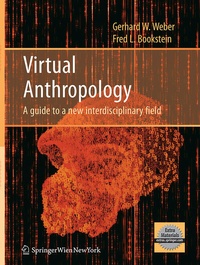
Virtual Anthropology
A guide to a new interdisciplinary field
Published on 5. May 2017
Book
Paperback/Softback
XXII, 423 pages
978-3-7091-1908-2 (ISBN)
Description
This is the first textbook of Virtual Anthropology, the new science that combines elements from fields as diverse as anthropology, medicine, statistics, computing, scientific visualization, and industrial design. The book is intended for students in any of these or nearby fields within biology, medicine, or engineering and for teachers, journalists, and all others who will enjoy the many examples from our real biological world. After a general introduction to the field and an overview, the book is organized around six themes conveyed in more than 300 pages of text accompanied by hundreds of carefully annotated images: medical imaging and 3D digitising techniques, electronic preparation of individual specimens, analysis of complex forms in space one or many at a time, reconstruction of forms that are partly missing or damaged, production of real objects from virtual models, and, finally, thoughts about data accessibility and sharing and the implications of all this for the future of anthropology. The authors' emphasis is not on technical details but rather on step-by-step explanations of the wealth of examples included here, from brain evolution to surgical planning, always in light of the relevance of these approaches to science and to society. All readers are encouraged to try out the techniques on their own using the tools and data included in the Online Extra Materials resource.
More details
Edition
Softcover reprint of the original 1st ed. 2011
Language
English
Place of publication
Vienna
Austria
Publishing group
Springer Wien
Target group
Professional and scholarly
Illustrations
XXII, 423 p.
Dimensions
Height: 279 mm
Width: 210 mm
Thickness: 25 mm
Weight
1084 gr
ISBN-13
978-3-7091-1908-2 (9783709119082)
DOI
10.1007/978-3-211-49347-2
Schweitzer Classification
Other editions
Additional editions
Book
12/2010
Springer
€90.94
Shipment within 10-15 days
Persons
Gerhard W. Weber is associate professor in the Department of Anthropology at the University of Vienna. A pioneer in digital extensions of anthropology since the early 1990s, he leads the Virtual Anthropology workgroup and the Vienna Micro-CT Lab as well as other projects at the University of Vienna towards centred on the new technology. He also established the digital@rchive of Fossil Hominoids and initiated and coordinated the EU-funded European Virtual Anthropology Network. He has been active for a decade in field work in the Afar Triangle in Ethiopia. His teaching comprises applied statistics, human evolution, and Virtual Anthropology. Fred L. Bookstein, an American, is Professor of Morphometrics at the University of Vienna and Professor of Statistics at the University of Washington, Seattle. He is the principal figure responsible for the emergence of Morphometrics over the last quarter-century as an interdisciplinary method combining medical imaging, analytic geometry, and multivariate statistics in novel tools for the analysis of biological form and its variation. The course he most enjoys teaching is Numbers and Reasons, about the origins of quantitative methods in the real world.
Content
Chapter 1: Virtual Anthropology: A new interdisciplinary field of science
Chapter 2: Mapping the physical world: Digitise
Chapter 3: Looking inside: Expose
Chapter 4: Using numbers: Compare
Chapter 5: Missing data: Reconstruct
Chapter 6: Back to the real world: Materialise
Chapter 7: Collaborate at the speed of light: Share
Chapter 8: Views into the future