

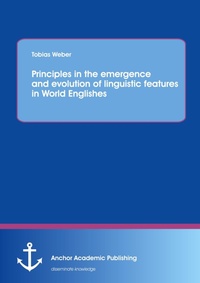
Principles in the emergence and evolution of linguistic features in World Englishes
Published on 30. January 2014
Book
Paperback/Softback
100 pages
978-3-95489-191-7 (ISBN)
Description
This study deals with different explanatory models for the emergence or existence of linguistic features in varieties of the English language. After a brief overview of the current research, five non-standard varieties from all over the world, ranging from a traditional dialect to pidgins and creoles, are analyzed in two morphosyntactic and two phonological features. The theoretical approaches are discussed with reference to the features, providing recommendations for or advice against certain explanatory models. Finally, Bybee's usage-based functionalist approach and the usage-based synthesis of new-dialect formation according to Ansaldo are highlighted as plausible explanations for the features. Formalist, descriptive universals are rejected in favour of functionalist, cognitive universals in human language processing, acquisition and evolution, as they occur in language contact or speaker contact scenarios - the driving force of language change.
More details
Language
English
Product notice
Paperback (trade)
Unsewn / adhesive bound
Dimensions
Height: 220 mm
Width: 155 mm
Thickness: 8 mm
Weight
173 gr
ISBN-13
978-3-95489-191-7 (9783954891917)
Copyright in bibliographic data and cover images is held by Nielsen Book Services Limited or by the publishers or by their respective licensors: all rights reserved.
Schweitzer Classification
Other editions
Additional editions
E-Book
02/2014
1st Edition
Anchor Academic Publishing
€44.99
Available for download
Person
Tobias Weber, M.Ed., was born in 1987 in Cottbus/Germany. He started his studies at Dresden University of Technology in 2006 and graduated as B.Ed. in 2010 with a first-hand account on Belfast's mural art and its socio-historical importance. After having spent one year abroad as a teaching assistant at Bedford Modern School, he enrolled again at Dresden University for a masters programme with a major in linguistics. His special interest in varieties of the English language worldwide led to this publication. He successfully graduated in 2013.