

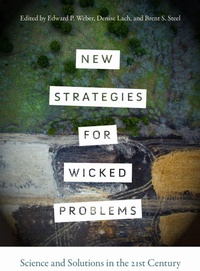
New Strategies for Wicked Problems
Science and Solutions in the 21st Century
Will be published approx. on 1. June 2017
Book
Paperback/Softback
248 pages
978-0-87071-893-9 (ISBN)
Description
A "wicked problem" isn't one with an evil nature, but a problem that is impossible or difficult to solve because of incomplete, contradictory, and changing requirements that are often hard to recognize. Classic examples of wicked problems include economic, environmental, and political issues. We now live in a world full of wicked problems, most of them urgent challenges calling out for creative, democratic, and effective solutions. Ed Weber, Denise Lach, and Brent Steel, of the Oregon State University School of Public Policy, solicited papers from a wide variety of accomplished scholars in the fields of science, politics, and policy to address this challenge. The resultant collection focuses on major contemporary environmental and natural resource policy issues, and proposes an assortment of alternative problem-solving methodologies to tackle such problems.
More details
Language
English
Place of publication
Corvallis, OR
United States
Target group
Professional and scholarly
Product notice
Paperback (trade)
Unsewn / adhesive bound
Illustrations
9 tables, 1 figure
Dimensions
Height: 226 mm
Width: 152 mm
Thickness: 18 mm
Weight
381 gr
ISBN-13
978-0-87071-893-9 (9780870718939)
Copyright in bibliographic data and cover images is held by Nielsen Book Services Limited or by the publishers or by their respective licensors: all rights reserved.
Schweitzer Classification
Persons
Edward P. Weber is the Ulysses G. Dubach Professor of Political Science in the School of Public Policy at Oregon State University. He has published widely on natural resource/environmental policymaking, policy implementation, democratic accountability, and the design and operation of alternative decision-making and governance institutions, particularly collaborative governance arrangements. He also is the Chair of the Committee for Family Forestlands for the Oregon Department of Forestry and the former leader of the Thomas Foley Public Policy Institute. Denise Lach is Professor of Sociology and Director of the School of Public Policy at Oregon State University. Her research focuses on the role of science and scientists in natural resources policymaking, including finding ways to visualize data to effectively communicate results. Her interdisciplinary research and teaching engages scholars, students, and decision-makers from fields as diverse as nuclear engineering and salmon biology. Brent S. Steel is Professor and the Director of the Graduate Program in the School of Public Policy at Oregon State University. He has published numerous journal articles, book chapters and books concerning public policy in areas such as forestry, rangelands, endangered species, coastal and marine issues, environmental issues, sustainable development, and the politicization of science. Other Contributors:
Tanya Heikkila
Helen Ingram
Ann C. Keller
Bob Lackey
Anna Pakenham Stevenson
Christopher M. Weible
Daniel R. Williams
Tanya Heikkila
Helen Ingram
Ann C. Keller
Bob Lackey
Anna Pakenham Stevenson
Christopher M. Weible
Daniel R. Williams