

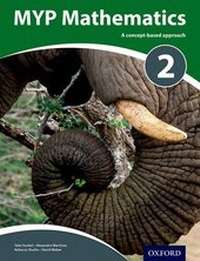
MYP Mathematics 2
Published on 1. November 2018
Book
Paperback/Softback
336 pages
978-0-19-835616-5 (ISBN)
Description
Build solid mathematical understanding and develop meaningful conceptual connections. The inquiry-based approach holistically integrates the MYP key concepts, helping you shift to a concept-based approach and cement comprehension of mathematical principles. Fully comprehensive and matched to the Revised MYP, this resource builds student potential at MYP and lays foundations for cross-curricular understanding. Using a unique question cycle to sequentially build skills and comprehension, units introduce factual questions, followed by concept-based questions and conclude with debatable questions. This firm grounding in inquiry-based learning equips learners to actively explore mathematical concepts and relate them to the wider 21st Century world, strengthening comprehension.
Progress your learners into IB Diploma - fully comprehensive and matched to the Revised MYP
Develop conceptual understanding in the best way for your learners - learn by mathematical unit or by key concept
Drive active, critical exploration of mathematical principles - build rounded comprehension framed within the key and related concepts
Develop meaningful cross-curricular connections that help learners recognize and manipulate mathematical ideas in other disciplines
Support higher level thinking skills through an approach grounded in factual, conceptual and debatable questions
Build a solid foundation of practical skills with extensive practice equipping learners to apply skills
Fully prepare learners for the MYP eAssessment
Progress your learners into IB Diploma - fully comprehensive and matched to the Revised MYP
Develop conceptual understanding in the best way for your learners - learn by mathematical unit or by key concept
Drive active, critical exploration of mathematical principles - build rounded comprehension framed within the key and related concepts
Develop meaningful cross-curricular connections that help learners recognize and manipulate mathematical ideas in other disciplines
Support higher level thinking skills through an approach grounded in factual, conceptual and debatable questions
Build a solid foundation of practical skills with extensive practice equipping learners to apply skills
Fully prepare learners for the MYP eAssessment
More details
Language
English
Place of publication
Oxford
United Kingdom
Target group
Primary & secondary/elementary & high school
Dimensions
Height: 255 mm
Width: 195 mm
Thickness: 18 mm
Weight
1 gr
ISBN-13
978-0-19-835616-5 (9780198356165)
Copyright in bibliographic data and cover images is held by Nielsen Book Services Limited or by the publishers or by their respective licensors: all rights reserved.
Schweitzer Classification
Other editions
New editions
David Weber | Talei Kunkel | Alexandra Martinez
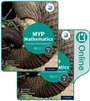
MYP Mathematics 2: Print and Enhanced Online Course Book Pack
MYP students - Year 2
Book
12/2018
Oxford University Press
€60.00
Available immediately
Additional editions

David Weber | Talei Kunkel | Alexandra Martinez
MYP Mathematics 2: Enhanced Online Course Book
Software
11/2018
Oxford University Press
€79.28
Shipment within 15-20 days
Content
Unit 1 Ratio and proportion: Competition and cooperation
1.1: Simplifying ratios
1.2: Equivalent ratios
1.3: Other ways to represent ratios
1.4: Solving proportions
1.5: Proportional reasoning
Unit 2 Probability: Games and play
2.1: Events and outcomes
2.2: Representing the sample space
2.3: Defining and representing probability
2.4: Calculating probability
2.5: Complementary events
2.6: Theoretical versus experimental probability
2.7: Simulations
Unit 3 Integers: Human explorations
3.1: What is an integer?
3.2: Absolute value
3.3: The coordinate grid
3.4: Multiplication and division
3.5: Addition and subtraction
3.6: Multiple operations
Unit 4 Algebra: Puzzles and tricks
4.1: Classifying algebraic expressions
4.2: Simplifying expressions
4.3: Writing expressions
4.4: Solving equations
4.5: Writing equations
4.6: Application of equations
4.7: Representing inequalities
4.8: Solving inequalities
Unit 5 Geometry: Human and natural landscapes
5.1: Area of trapezium
5.2: Area of regular polygons
5.3: Circumference and area of circles
5.4: Surface area of regular prisms
5.5: Volume of rectangular prisms
5.6: Volume of other prisms
Unit 6 Rates: Interconnectedness of human-made systems
6.1: What is a rate?
6.2: Converting measurements
6.3: Converting currencies
6.4: Unit rates and unit prices
6.5: Problem solving with rates
6.6: Rate of change
Unit 7 Univariate data: Accessing equal opportunities
7.1: Stem-and-leaf plots
7.2: Measures of central tendency (mean, median, mode)
7.3: The effect of outliers
7.4: Measures of dispersion (range and quartiles)
7.5: Box and whisker plots
1.1: Simplifying ratios
1.2: Equivalent ratios
1.3: Other ways to represent ratios
1.4: Solving proportions
1.5: Proportional reasoning
Unit 2 Probability: Games and play
2.1: Events and outcomes
2.2: Representing the sample space
2.3: Defining and representing probability
2.4: Calculating probability
2.5: Complementary events
2.6: Theoretical versus experimental probability
2.7: Simulations
Unit 3 Integers: Human explorations
3.1: What is an integer?
3.2: Absolute value
3.3: The coordinate grid
3.4: Multiplication and division
3.5: Addition and subtraction
3.6: Multiple operations
Unit 4 Algebra: Puzzles and tricks
4.1: Classifying algebraic expressions
4.2: Simplifying expressions
4.3: Writing expressions
4.4: Solving equations
4.5: Writing equations
4.6: Application of equations
4.7: Representing inequalities
4.8: Solving inequalities
Unit 5 Geometry: Human and natural landscapes
5.1: Area of trapezium
5.2: Area of regular polygons
5.3: Circumference and area of circles
5.4: Surface area of regular prisms
5.5: Volume of rectangular prisms
5.6: Volume of other prisms
Unit 6 Rates: Interconnectedness of human-made systems
6.1: What is a rate?
6.2: Converting measurements
6.3: Converting currencies
6.4: Unit rates and unit prices
6.5: Problem solving with rates
6.6: Rate of change
Unit 7 Univariate data: Accessing equal opportunities
7.1: Stem-and-leaf plots
7.2: Measures of central tendency (mean, median, mode)
7.3: The effect of outliers
7.4: Measures of dispersion (range and quartiles)
7.5: Box and whisker plots