

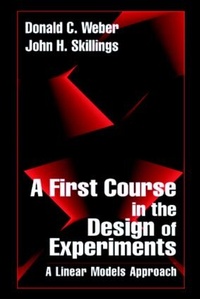
A First Course in the Design of Experiments
A Linear Models Approach
1st Edition
Published on 24. November 1999
Book
Hardback
420 pages
978-0-8493-9671-7 (ISBN)
Description
Most texts on experimental design fall into one of two distinct categories. There are theoretical works with few applications and minimal discussion on design, and there are methods books with limited or no discussion of the underlying theory. Furthermore, most of these tend to either treat the analysis of each design separately with little attempt to unify procedures, or they will integrate the analysis for the designs into one general technique.
A First Course in the Design of Experiments: A Linear Models Approach stands apart. It presents theory and methods, emphasizes both the design selection for an experiment and the analysis of data, and integrates the analysis for the various designs with the general theory for linear models.
The authors begin with a general introduction then lead students through the theoretical results, the various design models, and the analytical concepts that will enable them to analyze virtually any design. Rife with examples and exercises, the text also encourages using computers to analyze data. The authors use the SAS software package throughout the book, but also demonstrate how any regression program can be used for analysis.
With its balanced presentation of theory, methods, and applications and its highly readable style, A First Course in the Design of Experiments proves ideal as a text for a beginning graduate or upper-level undergraduate course in the design and analysis of experiments.
A First Course in the Design of Experiments: A Linear Models Approach stands apart. It presents theory and methods, emphasizes both the design selection for an experiment and the analysis of data, and integrates the analysis for the various designs with the general theory for linear models.
The authors begin with a general introduction then lead students through the theoretical results, the various design models, and the analytical concepts that will enable them to analyze virtually any design. Rife with examples and exercises, the text also encourages using computers to analyze data. The authors use the SAS software package throughout the book, but also demonstrate how any regression program can be used for analysis.
With its balanced presentation of theory, methods, and applications and its highly readable style, A First Course in the Design of Experiments proves ideal as a text for a beginning graduate or upper-level undergraduate course in the design and analysis of experiments.
Reviews / Votes
"I do like the blend of theory and methods found in the book and I would use it as a textbook for a first course on the design and analysis of experiments."-C. Brien, School of Mathematics, University of South Australia, Biometrics, December 2000
"...it is novel in combining the theory underlying the analysis of designed experiments with a description of the methods of designing and analyzing them. The theoretical development is deeper than many design and analysis textbooks."
Biometrics, Vol. 56, No. 4, December 2000
Promo Copy
More details
Language
English
Place of publication
Bosa Roca
United States
Publishing group
Taylor & Francis Inc
Target group
College/higher education
Professional and scholarly
Undergraduate
Illustrations
132 s/w Tabellen
132 Tables, black and white
Dimensions
Height: 234 mm
Width: 156 mm
Weight
860 gr
ISBN-13
978-0-8493-9671-7 (9780849396717)
Schweitzer Classification
Other editions
Additional editions
Book
06/2020
1st Edition
Routledge
€77.60
Shipment within 15-20 days
E-Book
05/2018
1st Edition
Routledge
€68.49
Available for download
E-Book
05/2018
1st Edition
Routledge
€68.49
Available for download
Persons
John H. Skillings, Donald Weber
Content
Introduction to the Design of Experiments. Linear Models.Least Squares Estimation and Normal Equations.Linear Model Distribution Theory.Distribution Theory for Statistical Inference.Inference for Multiple Regression Models.The Completely Randomized Design.Planned Comparisons.Multiple Comparisons.Randomized Complete Block Design.Incomplete Block Designs.Latin Square Designs.
Factorial Experiments with Two Factors.Other Factorial Experiments. Analysis of Covariance.Random and Mixed Models.Nested Designs and Associated Topics.Other Designs and Topics.Appendices.References.Index.
NTI/Sales Copy
Factorial Experiments with Two Factors.Other Factorial Experiments. Analysis of Covariance.Random and Mixed Models.Nested Designs and Associated Topics.Other Designs and Topics.Appendices.References.Index.
NTI/Sales Copy