

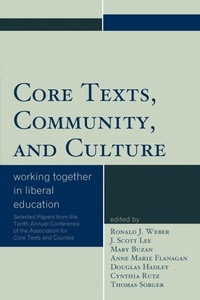
Core Texts, Community, and Culture
Working Together for Liberal Education
Published on 11. December 2009
Book
Paperback/Softback
224 pages
978-0-7618-4936-0 (ISBN)
Description
Throughout its existence, the Association for Core Texts and Courses (ACTC) has asserted its commitment to the need for humans to come together to speak about the scientific, the political, and the artistic in order to live together in an enlightened fashion. In 2004, ACTC's Tenth Annual Conference convened to re-affirm and re-examine the value of serious reading and discussion focused through core texts. Participants articulated the various ways by which core text education in the liberal arts constructs and supports different expressions of community on college campuses around the world. Presenters asked whether it is better to contemplate the arts simply as expressions of cultures and traditions or to cultivate them, taking the risk that what is valued in artistic expressions might be changed by the inventions of teachers and the students they encourage. The essays collected here reflect the responses of the diverse group of ACTC's members, all of whom support the idea of liberal core text education with the self-conscious awareness of the challenges facing liberal education in the modern academy.
More details
Series
Language
English
Place of publication
Lanham, MD
United States
Dimensions
Height: 229 mm
Width: 152 mm
Thickness: 13 mm
Weight
374 gr
ISBN-13
978-0-7618-4936-0 (9780761849360)
Copyright in bibliographic data and cover images is held by Nielsen Book Services Limited or by the publishers or by their respective licensors: all rights reserved.
Schweitzer Classification
Persons
Ronald J. Weber has been the director of the humanities (formerly Western Civilization) program at the University of Texas at El Paso since 1997. His Ph.D. is in ancient history from the University of Wisconsin.
J. Scott Lee has been the executive director and co-founder of the Association for Core Texts and Courses since 1994. His Ph.D. is from the Committee on the History of Culture, the University of Chicago.
J. Scott Lee has been the executive director and co-founder of the Association for Core Texts and Courses since 1994. His Ph.D. is from the Committee on the History of Culture, the University of Chicago.
Content
Chapter 1 Introduction
Part 2 Community: History and Forms
Chapter 3 Humanizing the Technological Vision: Core Learning and the Relation of the Sciences and Humanities
Chapter 4 Plato's Crito and the Development of Community
Chapter 5 Augustine's Intellectual Conversion
Part 6 Views of Community
Chapter 7 Beowulf: The Other Epic
Chapter 8 Montesquieu and the Problematic Character of Modern Citizenship
Chapter 9 Kleos and Kitsch: Postcard Patriotism in Derek Walcott's Omeros
Chapter 10 Lyric and the Skill of Life
Chapter 11 Achieving (Comm) Unity in Difference Through the Core Text
Part 12 Literary Experiences of Community
Chapter 13 The Music of Democracy: Core Values in Core Texts
Chapter 14 Nature and Tyranny in Aristophanes' Birds: The Real Meal Deal
Chapter 15 Lyrics Breath: Taking Seriously the Trope of Immortality in Shakespeare's Sonnets
Chapter 16 Whose Underground?: Notes on Locating Dostoyevsky
Part 17 Community: New Perspectives
Chapter 18 Art, Integrating Disciplinse, and Liberal Education: Imagining the Possible with Botticelli
Chapter 19 Culture and Patriarchy: The Egalitarian Vision of Woolf's Three Guineas
Chapter 20 Spoken from the Heart: Apprehending the Passion of Harriet Beecher Stowe
Chapter 21 Constructing and Deconstructing the Gospel of John
Part 22 Building Communities: Possibilities and Problems
Chapter 23 The "Mythical Method" as a Means to Community in Eliot's Murder in the Cathedral
Chapter 24 Captain Vere, Liberal Learning, and Leadership
Chapter 25 "Shall I Ever Attain My Heart's Desire?" or How a Flexible Approach to Core Texts is Building Layers of Community at Hanover College
Chapter 26 Educating for Justice: Service Learning and Plato's Republic
Part 27 Bridging the Gaps Between the Humanities and Sciences
Chapter 28 Natural Philosophy as a Liberal Art
Chapter 29 Euclid as Propadeutic
Chapter 30 Stealing the Power and Bridging the Gap: Ellison's Invisible Man as Core Text
Chapter 31 Connecting Principles in Adam Smith's History of Astronomy
Chapter 32 Darwin Redux: Great Texts and the Natural Sciences Revisited
Part 2 Community: History and Forms
Chapter 3 Humanizing the Technological Vision: Core Learning and the Relation of the Sciences and Humanities
Chapter 4 Plato's Crito and the Development of Community
Chapter 5 Augustine's Intellectual Conversion
Part 6 Views of Community
Chapter 7 Beowulf: The Other Epic
Chapter 8 Montesquieu and the Problematic Character of Modern Citizenship
Chapter 9 Kleos and Kitsch: Postcard Patriotism in Derek Walcott's Omeros
Chapter 10 Lyric and the Skill of Life
Chapter 11 Achieving (Comm) Unity in Difference Through the Core Text
Part 12 Literary Experiences of Community
Chapter 13 The Music of Democracy: Core Values in Core Texts
Chapter 14 Nature and Tyranny in Aristophanes' Birds: The Real Meal Deal
Chapter 15 Lyrics Breath: Taking Seriously the Trope of Immortality in Shakespeare's Sonnets
Chapter 16 Whose Underground?: Notes on Locating Dostoyevsky
Part 17 Community: New Perspectives
Chapter 18 Art, Integrating Disciplinse, and Liberal Education: Imagining the Possible with Botticelli
Chapter 19 Culture and Patriarchy: The Egalitarian Vision of Woolf's Three Guineas
Chapter 20 Spoken from the Heart: Apprehending the Passion of Harriet Beecher Stowe
Chapter 21 Constructing and Deconstructing the Gospel of John
Part 22 Building Communities: Possibilities and Problems
Chapter 23 The "Mythical Method" as a Means to Community in Eliot's Murder in the Cathedral
Chapter 24 Captain Vere, Liberal Learning, and Leadership
Chapter 25 "Shall I Ever Attain My Heart's Desire?" or How a Flexible Approach to Core Texts is Building Layers of Community at Hanover College
Chapter 26 Educating for Justice: Service Learning and Plato's Republic
Part 27 Bridging the Gaps Between the Humanities and Sciences
Chapter 28 Natural Philosophy as a Liberal Art
Chapter 29 Euclid as Propadeutic
Chapter 30 Stealing the Power and Bridging the Gap: Ellison's Invisible Man as Core Text
Chapter 31 Connecting Principles in Adam Smith's History of Astronomy
Chapter 32 Darwin Redux: Great Texts and the Natural Sciences Revisited