

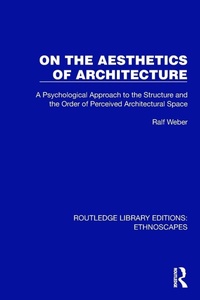
On the Aesthetics of Architecture
A Psychological Approach to the Structure and the Order of Perceived Architectural Space
1st Edition
Will be published approx. on 2. February 2026
Book
Paperback/Softback
292 pages
978-1-032-82091-0 (ISBN)
Description
Originally published in 1995 as part of the Ethnoscapes: Current Challenges in the Environmental Social Sciences series, reissued now with a new series introduction, On the Aesthetics of Architecture is a result of an interdisciplinary study in architectural theory, psychology and philosophy and the author's experience as a practicing architect. It tries to relate theories of aesthetics and recent advances in the psychology of visual perception to the practice of design.
The text starts with an analysis of traditional and contemporary schools of thought in architectural theory, and then proceeds through the formulation of a general theory of aesthetics based on perceptual and cognitive information processing to a description of the actual conditions under which aesthetic experiences of buildings and cities take place. It exemplifies principles of aesthetic appropriateness through an analysis of architectural space and form.
Weber's book attempts to move the discussion of architectural aesthetics beyond the shifting doctrines of style and the often ambiguous dicta of critics. While the author makes no claim that his interpretation of psychological research will result in good architecture, he does insist on the need to bring the discussion of form back to more objective grounds. As such, it provided a valuable teaching resource and an important new contribution to the discussion among architects themselves, as well as between psychologists, philosophers and art theorists at the time.
The text starts with an analysis of traditional and contemporary schools of thought in architectural theory, and then proceeds through the formulation of a general theory of aesthetics based on perceptual and cognitive information processing to a description of the actual conditions under which aesthetic experiences of buildings and cities take place. It exemplifies principles of aesthetic appropriateness through an analysis of architectural space and form.
Weber's book attempts to move the discussion of architectural aesthetics beyond the shifting doctrines of style and the often ambiguous dicta of critics. While the author makes no claim that his interpretation of psychological research will result in good architecture, he does insist on the need to bring the discussion of form back to more objective grounds. As such, it provided a valuable teaching resource and an important new contribution to the discussion among architects themselves, as well as between psychologists, philosophers and art theorists at the time.
More details
Series
Language
English
Place of publication
London
United Kingdom
Publishing group
Taylor & Francis Ltd
Target group
College/higher education
Adult education
Adult education, General, and Postgraduate
Dimensions
Height: 234 mm
Width: 156 mm
Thickness: 16 mm
Weight
459 gr
ISBN-13
978-1-032-82091-0 (9781032820910)
Copyright in bibliographic data and cover images is held by Nielsen Book Services Limited or by the publishers or by their respective licensors: all rights reserved.
Schweitzer Classification
Other editions
Additional editions
Ralf Weber
On the Aesthetics of Architecture
A Psychological Approach to the Structure and the Order of Perceived Architectural Space
Book
11/2024
1st Edition
Routledge
€152.00
Shipment within 10-20 days
Ralf Weber
On the Aesthetics of Architecture
A Psychological Approach to the Structure and the Order of Perceived Architectural Space
E-Book
11/2024
1st Edition
Routledge
€41.99
Available for download
Ralf Weber
On the Aesthetics of Architecture
A Psychological Approach to the Structure and the Order of Perceived Architectural Space
E-Book
11/2024
1st Edition
Routledge
€41.99
Available for download
Person
Ralf Weber, PhD (UC Berkeley) is a Senior Research Professor of Architecture at the Faculty of Architecture, Dresden University of Technology and heads the University's Color Competency Research Center and Color Teaching Collection that functions as the nucleus for interdisciplinary studies of color in the sciences and arts.
He received his Diploma in Architecture at the University of Dresden and thereafter he practiced architecture in the office of Rolf Gutbrodt/Frei Otto and taught at Stuttgart University before moving to Berkeley, CA, USA in 1980 where he received a PhD in Design Methodology, Environmental Psychology and Aesthetics. He taught for several years at UC Berkeley before he returned to Dresden after the reunification of Germany, when he was appointed Chair for Spatial Design in Architecture from 1994 to 2019, after which he was became head of the University Color Center. He has held visiting professorships in Ankara, Kent State, Florence, Potsdam and the School of Architecture, University of Oregon, Eugene.
In his teaching and research he attempts to build bridges between the disciplines of architecture and design on the one hand and the theories of aesthetics and visual perception on the other. He is the internationally published author of the books: On the Aesthetics of Architecture; Aesthetics and Architectural Composition; and Thema Material as well as numerous articles in the fields of architecture, aesthetics and environmental psychology and more recently in the field of color.
He received his Diploma in Architecture at the University of Dresden and thereafter he practiced architecture in the office of Rolf Gutbrodt/Frei Otto and taught at Stuttgart University before moving to Berkeley, CA, USA in 1980 where he received a PhD in Design Methodology, Environmental Psychology and Aesthetics. He taught for several years at UC Berkeley before he returned to Dresden after the reunification of Germany, when he was appointed Chair for Spatial Design in Architecture from 1994 to 2019, after which he was became head of the University Color Center. He has held visiting professorships in Ankara, Kent State, Florence, Potsdam and the School of Architecture, University of Oregon, Eugene.
In his teaching and research he attempts to build bridges between the disciplines of architecture and design on the one hand and the theories of aesthetics and visual perception on the other. He is the internationally published author of the books: On the Aesthetics of Architecture; Aesthetics and Architectural Composition; and Thema Material as well as numerous articles in the fields of architecture, aesthetics and environmental psychology and more recently in the field of color.
Content
New Series Introduction to the Reissue David Canter and David Stea. Preface. 1. The Issue of Form 2. Appraising Form: Theories Compared 3. Adopting the Aesthetic Attitude 4. Form and its Interpretation: The Role of Perception and Cognition and the Formation of Concepts 5. The Roles of Form and Meaning in the Formation of Judgements 6. Aesthetic Value: Analyzing the Effects of Form 7. Spatial Form in Architecture 8. Corporeal Form 9. Summary and Outlook. Notes. Bibliography. List of Figures.