

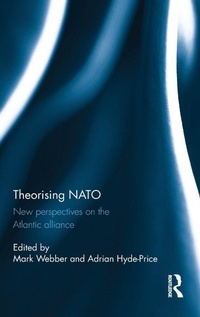
Theorising NATO
New perspectives on the Atlantic alliance
1st Edition
Published on 23. November 2015
Book
Hardback
208 pages
978-0-415-68899-4 (ISBN)
Description
Scholarship on NATO is often preoccupied with key episodes in the development of the organisation and so, for the most part, has remained inattentive to theory.
This book addresses that gap in the literature. It provides a comprehensive analysis of NATO through a range of theoretical perspectives that includes realism, liberalism and constructivism, and lesser-known approaches centred on learning, public goods, securitisation and risk. Focusing on NATO's post-Cold War development, it considers the conceptualisation, purpose and future of the Alliance.
This book will be of interest to students and scholars of international organisation, international relations, security and European Politics.
This book addresses that gap in the literature. It provides a comprehensive analysis of NATO through a range of theoretical perspectives that includes realism, liberalism and constructivism, and lesser-known approaches centred on learning, public goods, securitisation and risk. Focusing on NATO's post-Cold War development, it considers the conceptualisation, purpose and future of the Alliance.
This book will be of interest to students and scholars of international organisation, international relations, security and European Politics.
Reviews / Votes
"Theorising NATO is a useful exercise, worth reading for students and scholars of both NATO and IR theory. For NATO specialists, Webber and Hyde-Price's book provides new answers to old questions - especially the ones connected to NATO's persistence in the post-Cold War era. Both Flockhart's constructivist analysis and the contribution on securitisation by Gabi Schlag (Otto von Guericke University of Magdeburg) offer answers to this question that are not superficial. For IR theory enthusiasts, Theorising NATO attests concretely to the importance of theory in International Relations and provides a practical and powerful demonstration that multiple theoretical points of view can coexist and reinforce one another harmoniously, if considered with sufficient analytical eclecticism."Federico Palmieri, Istituto Affari Internazionali (IAI), The International Spectator
More details
Language
English
Place of publication
London
United Kingdom
Publishing group
Taylor & Francis Ltd
Target group
College/higher education
Postgraduate and Undergraduate
Illustrations
3 s/w Abbildungen, 3 s/w Zeichnungen, 7 s/w Tabellen
7 Tables, black and white; 3 Line drawings, black and white; 3 Illustrations, black and white
Dimensions
Height: 240 mm
Width: 161 mm
Thickness: 19 mm
Weight
570 gr
ISBN-13
978-0-415-68899-4 (9780415688994)
Copyright in bibliographic data and cover images is held by Nielsen Book Services Limited or by the publishers or by their respective licensors: all rights reserved.
Schweitzer Classification
Other editions
Additional editions
Book
10/2017
1st Edition
Routledge
€73.60
Shipment within 15-20 days
E-Book
11/2015
Routledge
€67.49
Available for download
E-Book
11/2015
Routledge
€67.49
Available for download
Persons
Mark Webber is Professor of International Politics and Head of the School of Government and Society at the University of Birmingham, UK.
Adrian Hyde-Price is Professor of Political Science at Gothenburg University, Sweden.
Adrian Hyde-Price is Professor of Political Science at Gothenburg University, Sweden.
Content
1 Introduction: is NATO a theory-free zone? Mark Webber 2 Theorising NATO Adrian Hyde-Price 3 NATO and the European security system: a neo-realist analysis Adrian Hyde-Price 4 Neo-classical realism and alliance politics James Sperling 5 NATO and institutional theories of international relations Frank Schimmelfennig 6 NATO and liberal International Relations theory Benjamin Pohl 7 Understanding NATO through constructivist theorizing Trine Flockhart 8 Securitization theory and the evolution of NATO Gabi Schlag 9 NATO and the risk society: modes of Alliance representation since 1991 Michael J. Williams 10 NATO - a public goods provider Jens Ringsmose 11 Learning the hard way: NATO's Civil-Military Cooperation Joerg Noll and Sebastiaan Rietjens