

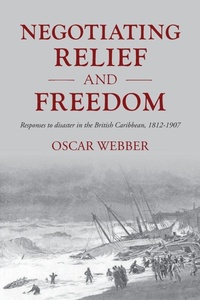
Negotiating Relief and Freedom
Responses to Disaster in the British Caribbean, 1812-1907
Will be published approx. on 20. January 2026
Book
Paperback/Softback
208 pages
978-1-5261-9486-2 (ISBN)
Description
Negotiating relief and freedom is an investigation of short- and long-term responses to disaster in the British Caribbean colonies during the 'long' nineteenth century. It explores how colonial environmental degradation made their inhabitants both more vulnerable to and expanded the impact of natural phenomena such as hurricanes, earthquakes, and volcanic eruptions. It shows that British approaches to disaster 'relief' prioritised colonial control and 'fiscal prudence' ahead of the relief of suffering. In turn, that this pattern played out continuously in the long nineteenth century is a reminder that in the Caribbean the transition from slavery to waged labour was not a clean one. Times of crisis brought racial and social tensions to the fore and freedoms once granted, were often quickly curtailed. -- .
Reviews / Votes
Negotiating relief and freedom provides a thorough and rich study. Webber introduces a more profound concern with the political, economic, and social dimensions of rebuilding society in the wake of disaster.-Rasmus Christensen, New West Indian Guide -- .
More details
Series
Language
English
Place of publication
Manchester
United Kingdom
Target group
College/higher education
Professional and scholarly
Dimensions
Height: 234 mm
Width: 156 mm
Thickness: 11 mm
Weight
292 gr
ISBN-13
978-1-5261-9486-2 (9781526194862)
Copyright in bibliographic data and cover images is held by Nielsen Book Services Limited or by the publishers or by their respective licensors: all rights reserved.
Schweitzer Classification
Person
Oscar Webber has been previously temporarily employed at the University of Leeds, The London School of Economics and has held a research fellowship at the Centre for Latin American and Caribbean Studies at the University of London -- .
Content
Introduction
1 Disaster and providence
2 Passing visitors
3 'Aid' in the absence of freedom
4 'Freedom', decline and fear
5 Practical sympathy
Conclusion -- .
1 Disaster and providence
2 Passing visitors
3 'Aid' in the absence of freedom
4 'Freedom', decline and fear
5 Practical sympathy
Conclusion -- .