

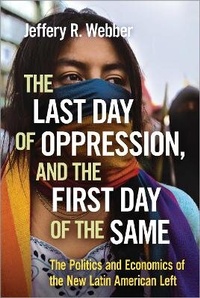
The Last Day of Oppression, and the First Day of the Same
The Politics and Economics of the New Latin American Left
Published on 20. January 2017
Book
Paperback/Softback
336 pages
978-0-7453-9953-9 (ISBN)
Description
In this penetrating volume, Jeffery Webber charts the political dynamics and conflicts underpinning the contradictory evolution of left-wing governments and social movements in Latin America in the last two decades.
Throughout the 2000s, Latin America transformed itself into the leading edge of anti-neoliberal resistance in the world. But what is left of the Pink Tide today? What are the governments' relationships to the explosive social movements that first propelled them to power? And as China's demand for Latin American commodities slackens, is there a viable economic strategy based on continued natural resource extraction?
Webber approaches these questions through an analysis of capitalist accumulation from 1990 to 2015 in Argentina, Bolivia, Brazil, Chile, Ecuador and Venezuela. He explains these countries' patterns of inequality through a decolonial Marxist framework, rooted in a new understanding of class and its complex associations with racial and gender oppression. He also discusses indigenous and peasant resistance to the expansion of private mining, agro-industry and natural gas and oil activities. The book concludes with chapters on 'passive revolution' in Bolivia under Evo Morales and debates around dual power and class composition during the era of Hugo Chavez in Venezuela.
Throughout the 2000s, Latin America transformed itself into the leading edge of anti-neoliberal resistance in the world. But what is left of the Pink Tide today? What are the governments' relationships to the explosive social movements that first propelled them to power? And as China's demand for Latin American commodities slackens, is there a viable economic strategy based on continued natural resource extraction?
Webber approaches these questions through an analysis of capitalist accumulation from 1990 to 2015 in Argentina, Bolivia, Brazil, Chile, Ecuador and Venezuela. He explains these countries' patterns of inequality through a decolonial Marxist framework, rooted in a new understanding of class and its complex associations with racial and gender oppression. He also discusses indigenous and peasant resistance to the expansion of private mining, agro-industry and natural gas and oil activities. The book concludes with chapters on 'passive revolution' in Bolivia under Evo Morales and debates around dual power and class composition during the era of Hugo Chavez in Venezuela.
Reviews / Votes
'If you have ever wondered what happened to the beacon of hope that was, until recently, Latin America, this is the book to turn to' -- Andreas Malm, author of Fossil Capital: The Rise of Steam Power and the Roots of Global Warming (Verso, 2015) 'Combining a Marxist and a decolonial theoretical framework, Webber brings us much more than a study on economic policies: an insightful assessment of class struggles against the capitalist oligarchies and the market dictatorship in Latin America' -- Michael Loewy, author of Ecosocialism: A Radical Alternative to Capitalist Catastrophe (Haymarket, 2015) 'At a time when most scholars of contentious politics have abandoned political economy, Jeffery Webber's latest book is a breath of fresh air ... simply the best book we have on the rise and current crisis of the new Latin American Left' -- Jeff Goodwin, New York University 'A lucid, incisive and indispensable contribution for understanding the rise and fall of left and center-left governments associated with Latin America's 'pink tide.' Webber validates the superiority of a critical Marxian and decolonial approach for slicing through the thick layers of the center-left's self-serving rhetoric' -- Fernando Leiva, author of Latin American Neostructuralism: The Contradictions of Post-Neoliberal Development '[A] comprehensive analysis of the rise and recent crisis of the wave of progressive governments in Latin America ... Webber steers a judicious path between the uncritical cheerleaders of this process and those who deny any real gains' -- Socialist Resistance 'I strongly recommend that people grappling with the political crisis of left governments in Latin America buy his book and pay close attention to his arguments' -- Louis Proyect, CounterpunchMore details
Language
English
Place of publication
London
United Kingdom
Target group
Professional and scholarly
Product notice
Paperback (UK-trade)
Illustrations
16 Tables, black and white
Dimensions
Height: 229 mm
Width: 152 mm
Weight
502 gr
ISBN-13
978-0-7453-9953-9 (9780745399539)
Copyright in bibliographic data and cover images is held by Nielsen Book Services Limited or by the publishers or by their respective licensors: all rights reserved.
Schweitzer Classification
Other editions
Additional editions
Jeffery Webber
The Last Day of Oppression, and the First Day of the Same
The Politics and Economics of the New Latin American Left
E-Book
01/2017
Pluto Press
€22.49
Available for download
Person
Jeffery R. Webber is Senior Lecturer in the School of Politics and International Relations, Queen Mary University of London. He is the author of Red October (Haymarket Books, 2012), From Rebellion to Reform in Bolivia (Haymarket Books, 2011) and The Last Day of Oppression, and the First Day of the Same (Pluto, 2017). With Todd Gordon, he is co-author of Blood of Extraction (Fernwood Publishing, 2016).
Content
1. Latin America's Second Independence
2. Global Crisis and Latin American Tendencies: The Political Economy of the New Latin American Left
3. Contemporary Latin American Inequality: Class Struggle, Decolonization and the Limits of Liberal Citizenship
4. The Indigenous Community as 'Living Organism': Jose Carlos Mariategui, Romantic Marxism and Extractive Capitalism in the Andes
5. Chile's New Left: More Than a Student Movement
6. Evo Morales and the Political Economy of Passive Revolution in Bolivia, 2006-2016
7. The Long March East: Evo Morales and the Consolidation of Agrarian Capitalism in Bolivia
8. Dual Powers, Class Compositions and the Venezuelan People: Reflections on We Created Chavez
9. Conclusion: From Hegemony to Impasse
Acknowledgements
Index
2. Global Crisis and Latin American Tendencies: The Political Economy of the New Latin American Left
3. Contemporary Latin American Inequality: Class Struggle, Decolonization and the Limits of Liberal Citizenship
4. The Indigenous Community as 'Living Organism': Jose Carlos Mariategui, Romantic Marxism and Extractive Capitalism in the Andes
5. Chile's New Left: More Than a Student Movement
6. Evo Morales and the Political Economy of Passive Revolution in Bolivia, 2006-2016
7. The Long March East: Evo Morales and the Consolidation of Agrarian Capitalism in Bolivia
8. Dual Powers, Class Compositions and the Venezuelan People: Reflections on We Created Chavez
9. Conclusion: From Hegemony to Impasse
Acknowledgements
Index