

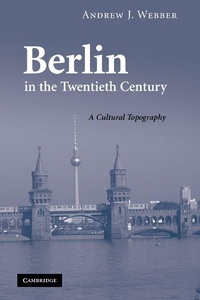
Berlin in the Twentieth Century
A Cultural Topography
Published on 3. March 2011
Book
Paperback/Softback
332 pages
978-0-521-18874-6 (ISBN)
Description
Berlin has been the focal scene of some of the most dramatic and formative events of the twentieth century. Through periods of decadence, fascism, war, partition and reunification, it has seen both extraordinary constraint and creativity. Andrew Webber explores the cultural topography of Berlin and considers the city as key capital of the twentieth century, reflecting its history, its traumas and its achievements. He shows how its spaces and buildings participate in the drama by analysing how they are represented in literature and film. Taking his methodology from Walter Benjamin, Webber presents bold readings of works synonymous with Berlin, with authors from Bertolt Brecht and Franz Kafka to Christa Wolf, and directors from Walther Ruttmann to Rainer Werner Fassbinder and Wim Wenders. Across this range of material, twentieth-century Berlin is seen to be as ambivalent as it is fascinating.
Reviews / Votes
'Webber has achieved an inspiring account of the mise-en-scene of Berlin city-space in the film and literature of the twentieth century, and one that is eminently worth reading.' ArchivMore details
Language
English
Place of publication
Cambridge
United Kingdom
Target group
College/higher education
Product notice
Paperback (trade)
Illustrations
Worked examples or Exercises
Dimensions
Height: 229 mm
Width: 152 mm
Thickness: 20 mm
Weight
540 gr
ISBN-13
978-0-521-18874-6 (9780521188746)
Copyright in bibliographic data and cover images is held by Nielsen Book Services Limited or by the publishers or by their respective licensors: all rights reserved.
Schweitzer Classification
Other editions
Additional editions
Book
09/2008
Cambridge University Press
€124.30
Shipment within 15-20 days
Person
Content
Foreword: Berlin is worth a journey; Introduction: capital of the twentieth century?; 1. Berlin chronicle: thresholds and boundaries; 2. Berlin ensemble: inhabitations and accommodations; 3. Berlin symphonies: movements and stills; 4. Berlin Alexanderplatz: alterations and reconstructions; 5. Berlin Wall: divisions and falls; 6. Berlin marathon: openings and closures; Afterword: Goodbye to Berlin?; Bibliography.