

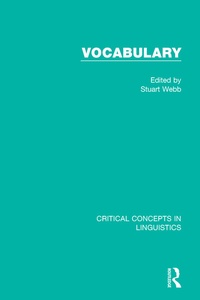
Vocabulary
Will be published approx. on 28. April 2016
Book
Hardback
440 pages
978-1-138-83864-2 (ISBN)
Description
Although there is a long history of research on vocabulary, the vast majority of studies have appeared over the last 30 years. This new reference work will provide a comprehensive source of the most influential findings that will be both a useful starting point for developing knowledge of the field, as well as a valuable database that can be relied upon when researching vocabulary. Comprised of 4 volumes, the collection will cover 4 key areas. Volume 1 will focus on the core issues related to vocabulary knowledge. The focus of volume 2 is on incidental vocabulary learning. Volume 3 explores the deliberate instruction of vocabulary, and volume 4 looks at formulaic language.
More details
Language
English
Place of publication
London
United Kingdom
Publishing group
Taylor & Francis Ltd
Target group
College/higher education
Illustrations
82 s/w Tabellen
82 Tables, black and white
Dimensions
Height: 234 mm
Width: 156 mm
Weight
453 gr
ISBN-13
978-1-138-83864-2 (9781138838642)
Copyright in bibliographic data and cover images is held by Nielsen Book Services Limited or by the publishers or by their respective licensors: all rights reserved.
Schweitzer Classification
Other editions
Additional editions
Person
Content
Volume 1: The Foundations of Research on Vocabulary; Volume 2: Incidental Vocabulary Learning; Volume 3: Deliberate Vocabulary Learning; Volume 4: Formulaic Language
VOLUME IV: Introduction: examining research investigating multi-word combinations PART 14 What are multi-word combinations and to what extent do they occur? 49 Two puzzles for linguistic theory: nativelike selection and nativelike fluency 50 The functions of formulaic language: an integrated model 51 The treatment of collocations and idioms in learners' dictionaries 52 Going beyond patterns: involving cognitive analysis in the learning of collocations PART 15 Which multi-word combinations deserve to be deliberately learned? 53 A phrasal expressions list 54 An academic formulas list: new methods in phraseology research 55 If you look at: lexical bundles in university teaching and textbooks PART 16 Measuring multi-word combinations 56 Measurement of formulaic sequences 57 Designing and evaluating tests of receptive collocation knowledge: COLLEX and COLLMATCH PART 17 To what extent are multi-word combinations known? 58 Should we teach EFL students collocations? 59 The development of collocation use in academic texts by advanced L2 learners: a multiple case study approach PART 18 How easily are multi-word combinations learned? 60 The use of collocations by advanced learners of English and some implications for teaching 61 Gauging the effects of exercises on verb-noun collocations62 The effect of known-and-unknown word combinations on intentional vocabulary learning 63 Experimental and intervention studies on formulaic sequences in a second language 64 Incidental learning of collocation 65 Presenting figurative idioms with a touch of etymology: more than mere mnemonics?
VOLUME IV: Introduction: examining research investigating multi-word combinations PART 14 What are multi-word combinations and to what extent do they occur? 49 Two puzzles for linguistic theory: nativelike selection and nativelike fluency 50 The functions of formulaic language: an integrated model 51 The treatment of collocations and idioms in learners' dictionaries 52 Going beyond patterns: involving cognitive analysis in the learning of collocations PART 15 Which multi-word combinations deserve to be deliberately learned? 53 A phrasal expressions list 54 An academic formulas list: new methods in phraseology research 55 If you look at: lexical bundles in university teaching and textbooks PART 16 Measuring multi-word combinations 56 Measurement of formulaic sequences 57 Designing and evaluating tests of receptive collocation knowledge: COLLEX and COLLMATCH PART 17 To what extent are multi-word combinations known? 58 Should we teach EFL students collocations? 59 The development of collocation use in academic texts by advanced L2 learners: a multiple case study approach PART 18 How easily are multi-word combinations learned? 60 The use of collocations by advanced learners of English and some implications for teaching 61 Gauging the effects of exercises on verb-noun collocations62 The effect of known-and-unknown word combinations on intentional vocabulary learning 63 Experimental and intervention studies on formulaic sequences in a second language 64 Incidental learning of collocation 65 Presenting figurative idioms with a touch of etymology: more than mere mnemonics?