

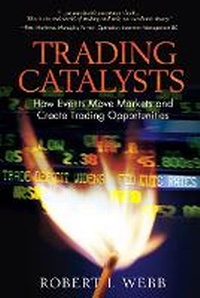
Trading Catalysts
How Events Move Markets and Create Trading Opportunities
Published on 12. October 2006
Book
Hardback
368 pages
978-0-13-038556-7 (ISBN)
Description
In Trading Catalysts, Robert I. Webb examines the various factors that move markets. Webb focuses on the catalysts that spark the biggest price changes-and the greatest potential for substantial profits or losses. Using numerous real market examples, Webb demonstrates the often inconsistent response of prices to similar trading catalysts across markets and over time, the occasional significantly delayed response, and the frequent market overreaction. Whether traders bet directly on a trading catalyst, on the presumed market reaction (or overreaction) to it, or not at all, the potential impact on market prices and volatility means that all traders must pay attention to trading catalysts and the market reactions that they induce. At the very least, the prospect of significant volatility around some event may affect the timing of a trader's entry or exit of positions and may cause a trader to reduce his position size. If you're a serious trader, this book will help you understand the influence of trading catalysts and identify potential trading opportunities.
Volatile financial markets create both the risk of substantial losses and the opportunity for substantial gains. Sudden jumps or breaks in prices can impart a roller-coaster-ride-like quality to trading or investing in financial markets. Trading Catalysts is the first complete guide to the events that spark large changes in prices. These include: central bank actions; ill-advised comments by policymakers; news of natural disasters; elections; certain economic reports; terrorism; company specific announcements; the unwinding of large positions by key market participants; and simple trading errors among others. The varied origin of trading catalysts means that some traders may have an edge in anticipating the market's reaction to certain trading catalysts. Numerous real market examples take the reader into the heart of the market to illustrate the direction, magnitude, speed, duration, intensity and breadthof influence of trading catalysts on market prices. Because a minute can be a "lifetime" in the world of trading, many of the detailed examples recount moment-by-moment and tick-by-tick changes in market prices. This book discusses the role that trading theses(or prevailing beliefs about market relationships), market conditions,and sentimentplay in determining how prices react and sometimes overreact to various trading catalysts over time. Trading Catalysts will help readers anticipate potential events that could spark rallies or breaks; predict situations with feedback loops that drive markets up or down; and identify situations where substantial overreactions are likely to occur.
Volatile financial markets create both the risk of substantial losses and the opportunity for substantial gains. Sudden jumps or breaks in prices can impart a roller-coaster-ride-like quality to trading or investing in financial markets. Trading Catalysts is the first complete guide to the events that spark large changes in prices. These include: central bank actions; ill-advised comments by policymakers; news of natural disasters; elections; certain economic reports; terrorism; company specific announcements; the unwinding of large positions by key market participants; and simple trading errors among others. The varied origin of trading catalysts means that some traders may have an edge in anticipating the market's reaction to certain trading catalysts. Numerous real market examples take the reader into the heart of the market to illustrate the direction, magnitude, speed, duration, intensity and breadthof influence of trading catalysts on market prices. Because a minute can be a "lifetime" in the world of trading, many of the detailed examples recount moment-by-moment and tick-by-tick changes in market prices. This book discusses the role that trading theses(or prevailing beliefs about market relationships), market conditions,and sentimentplay in determining how prices react and sometimes overreact to various trading catalysts over time. Trading Catalysts will help readers anticipate potential events that could spark rallies or breaks; predict situations with feedback loops that drive markets up or down; and identify situations where substantial overreactions are likely to occur.
Reviews / Votes
The book provides broad, interesting coverage of these trading catalysts...-- H. Mayo, The College of New Jersey (Reprinted with permission from CHOICE, copyright by the American Library Association)
More details
Language
English
Place of publication
Upper Saddle River
United States
Publishing group
Pearson Education (US)
Target group
Professional and scholarly
Dimensions
Height: 159 mm
Width: 236 mm
Thickness: 30 mm
Weight
699 gr
ISBN-13
978-0-13-038556-7 (9780130385567)
Copyright in bibliographic data and cover images is held by Nielsen Book Services Limited or by the publishers or by their respective licensors: all rights reserved.
Schweitzer Classification
Other editions
New editions
Robert Webb | Robert I. Webb
Trading Catalysts: How Events Move Markets and Create Trading Opportunities
How Events Move Markets and Create Trading Opportunities
Book
02/2012
1st Edition
Addison Wesley
€41.49
Shipment within 15-20 days
Person
Robert I. Webb teaches Financial Trading at both the McIntire School of Commerce and the Darden Graduate School of Business Administration at the University of Virginia. His research focuses on derivative securities and markets, trading, and incentive economics. He is the author of Macroeconomic Information and Financial Trading(Oxford, 1994) and has written numerous academic papers. Webb has traded treasury bonds and other fixed income securities for the Investment Department of the World Bank; traded futures as a "local" on the floor of the Chicago Mercantile Exchange; designed new financial futures and option contracts for the Chicago Mercantile Exchange; served in the Executive Office of the President, Office of Management and Budget during President Reagan's first term; and served at the Commodity Futures Trading Commission. He previously taught at the University of Southern California. Webb is editor of The Journal of Futures Markets, a leading academic journal on derivative securities and markets. He earned his Ph.D. in finance from the University of Chicago, and has published widely in both academic journals and the financial press.
Content
Preface
Chapter 1: Introduction
Chapter 2: Market Conditions and Sentiment
Chapter 3: Talk Isn't Cheap
Chapter 4: Geopolitical Events
Chapter 5: Weather and Natural Disasters
Chapter 6: Market Interventions
Chapter 7: Periodic Economic Reports
Chapter 8: Size Matters
Chapter 9: Bubbles, Crashes, Corners, and Market Crises
Chapter 10: The Accidental Catalyst
Index
Chapter 1: Introduction
Chapter 2: Market Conditions and Sentiment
Chapter 3: Talk Isn't Cheap
Chapter 4: Geopolitical Events
Chapter 5: Weather and Natural Disasters
Chapter 6: Market Interventions
Chapter 7: Periodic Economic Reports
Chapter 8: Size Matters
Chapter 9: Bubbles, Crashes, Corners, and Market Crises
Chapter 10: The Accidental Catalyst
Index